I have written three fan letters in my time. One to Ann M. Martin, author of the Baby Sitter's Club books, J.K. Rowling, of well, you know who fame, and Stuart Mclean, the author/creator of the Vinyl Cafe stories. I think I know where the return letter from Stuart is stashed, unfortunately I don't think I have the others.
Of course, I'm not even remotely famous, and the last time I checked my sales, I'd made a whopping $14.00, so I don't expect to get my own fan mail anytime soon. However, I thought since not much has been happening around the Milne household over the last few weeks, I might answer some questions that I imagine might be asked in a letter or email.
Q: How long have your been writing stories?
Years. At least since I was ten, when I wrote my first one act Christmas play. I've always written short stories, and during my first year of university, I emailed a serial to my friends, about an alternate universe where everyone had peg-legs. I moved onto novels after I graduated from nursing.
Q: Did you take any special classes or courses to learn how to write?
Yes. After I finished with nursing, I spend three semesters at Seton Hill in their Writing Popular Fiction program. Unfortunately, I didn't graduate after loosing my focus in my fourth and final semester. Even though I didn't graduate from the program, it improved my writing skills considerably. Although I still feel that the ability to create a good story is largely innate, courses and classes in writing can definitely strength your skills.
Q: How many stories involving Nora do you have planned?
It will take three stories to complete Nora's tale and I don't have plans to do any more after that. I often lose interest in a series that goes on for longer, especially if the characters suffer what I think of as "the most unlucky person in the world" syndrome. Three stories will take Nora to the end of her journey, with most of her goals met, and a great deal of personal growth accomplished.
Q: Do you have any other stories you're working on, or have published?
Yes. I have an upper YA novel, title Cimwai's Bay, which I'm currently querying to agents. If, by the time I've released all of Nora's stories, I haven't managed to find someone to pick up the series, I'll also release it via self publishing. After all, the key to success with self-publishing is to have as many novels on the market as possible.
Q: What do you like best about writing?
I like to entertain people with stories. When I was younger, I told lots of jokes, and I've always liked to act and sing. Since I'm not an especially good actor or singer, writing is another avenue for entertaining. Plus, I tend to have no shortage of ideas to write about, although they don't always make it into a novel.
Q: What do you like the least about writing?
The amount of time you have to spend sitting at a desk with just a computer. I'm naturally an introvert, so it's not as huge a sacrifice as it might be for those of a more social nature. Also, I often feel guilty when I opt to watch a movie, or go out for an evening rather than write. It's one of those hard facts about being (or trying to be a writer), it takes a lot of time to craft a novel.
If you have any questions for me about writing, knitting, baking, or being an aerialist, feel free to post them (Note: I do moderate my comments, so it make take a while for them to appear).
Ciao,
Andrea
Showing posts with label YA story. Show all posts
Showing posts with label YA story. Show all posts
Thursday, November 21, 2013

Friday, November 8, 2013
The Cure, Q&A: Meet Tomas Classen
Now it's time to meet Tomas Classen.
I can't recall if I've written this here before, but I'm an enormous figure skating fan (since the early 1990's, when Kurt Browning was competing) and I frequently have dreams involving figure skaters. Of course, these dreams rarely involve figure skating, the skaters who make appearances are usually just hanging out with me. At any rate, when I had my dream about living in the airplane hanger, it also involved a Canadian figure skater, one Jeffrey Buttle. He was one of the 'cool' kids, and I definitely was not, and he's the body model for Tomas.
Of course, I have no idea what Jeffrey is really like (I can only surmise from the interviews I've seen of him, that he's generally a friendly, charismatic type of person) so technically, Tomas is only based on him physically speaking. Therefore, Tomas isn't terribly tall, only five foot eight (the ideal height for most male figure skaters is in the five foot six to five foot eight range, it's a centre of gravity thing required for jumps and spins) and he's physically fit, very trim, but not beefy. His hair is multi-hued, but is predominantly a golden-blond colour, and his eyes are described as crystal blue. I definitely made Tomas something of a pretty-boy.
Personality wise, Tomas is meant to be very charming, open, and friendly towards everyone. He's the daydream of every girl in the compound, and he tries not to encourage anyone's hopes, but since he's a genuinely nice person, he has trouble discouraging the attention he doesn't want (hence why Ursula and Rose thinks he actually considers them as his close personal friends). He's also much better at keeping his temper under wraps than Nora, but that doesn't mean he never gets angry. Rather, when he gets mad, he gets really mad, and that most often happens when he feels he needs to defend Nora.
Finally, we don't get to learn much of Tomas's aspiration in The Cure, (you don't even get to learn much about them in The Cause, either), but since it's really not a spoiler, I'll tell you. He'd like to go into records management (did I mention I'm a librarian?), which has a limited job field, especially in a small compound like Nu. That's about all I can say about that.
Again, let me know if you have questions! Feel free to post them to this blog, or to post them on Facebook if that's where your reading this from. I'd be happy to answer them.
Ciao,
Andrea
I can't recall if I've written this here before, but I'm an enormous figure skating fan (since the early 1990's, when Kurt Browning was competing) and I frequently have dreams involving figure skaters. Of course, these dreams rarely involve figure skating, the skaters who make appearances are usually just hanging out with me. At any rate, when I had my dream about living in the airplane hanger, it also involved a Canadian figure skater, one Jeffrey Buttle. He was one of the 'cool' kids, and I definitely was not, and he's the body model for Tomas.
 |
| Jeffrey Buttle, 2008 World Champion. I linked to this picture through Wikipedia, but I don't know where they scammed it from (hey, I'm a librarian, if I can't source something accurately, I can at least be honest about it). |
 |
| My brother, Matthew Thorne's, rendition of Tomas. |
 |
| My own sketch of Tomas, working in the greenhouse. |
Again, let me know if you have questions! Feel free to post them to this blog, or to post them on Facebook if that's where your reading this from. I'd be happy to answer them.
Ciao,
Andrea
Thursday, October 31, 2013
The Cure, Q&A: Meet Nora Watson
I don't have a consistent practice for how I develop characters. It all depends on what arises first, the idea for the story, or the idea for the character. Sometimes I'll have a particular person in mind as a body double, often I don't. What I intentionally do, is avoid giving a great deal of description to my main character so that my readers might reasonably imagine themselves as the protagonist. Although, since most of my lead characters are female, that might not work so well for any male readers, but maybe it doesn't matter so much. I don't know.
For Nora, I didn't have particular description in mind. I thought she was probably of average appearance, so pretty, but of course she wouldn't have acknowledged such a compliment if it was passed her way. She has long brown hair (it's way easier to just let your hair grow, then ever cut it or style it) that she generally ties back into a ponytail or messy bun, and she had brown eyes. She looks a lot like her mother. She's about five foot six, or 168 centimeters tall (or my height) and slender.
Of course, there's a lot more to Nora than her appearance. As I was developing the story for The Cure I decided that there needed to be something unique about her. She couldn't just be some smart, average of appearance, teenage girl who was awkward with people. There had to be something else. There had to be a reason for why she had so few friends, why she was an outcast for more than just the purposes of my story. That's why I made her deaf.
I've been fascinated with the deaf culture since I was young...since I first saw The Miracle Worker, which is a movie (starring Anne Bancroft) about the early childhood of Helen Keller. I've always admired that she achieved so much considering she was both blind and deaf. I know some sign language (although not nearly enough to successfully communicate with a deaf person, I'm sure), and I volunteered at the Bob Rumbell Centre for the Deaf in Toronto for a short period during my undergrad. I also took several opportunities in my Masters to work on projects related to the Deaf culture.
I have one small regret around making Nora deaf, and that's that I made her deaf and not Deaf. That means she's physiologically deaf, but not culturally. The reason for this is that, she's the only deaf person in her compound. She had no one to learn from. This is why she speaks and reads lips, rather than uses ASL. I try to point out in a couple of places that lip reading isn't perfect, that she can't understand what people are saying when they don't look at her, and even then, she has to fill in bits as best she can. I also have people occasionally remark on her unusual 'accent,' to note that her speaking voice is differentl because she can't hear it herself.
Small piece of back story that never comes out--Nora's mother was sick when she was pregnant (Rubella), which is why Nora is deaf.
Finally, I made Nora a huge science nerd. That's because I wanted to demonstrate that girls can be smart at science, too. I was kind of an all around student in elementary and high school. I was good at music and art, but I also achieved good grades in math and science. I did, after all, start out my university career in biology.
So, there's the background on Nora Watson, my heroine.
Feel free post questions if you want to know more about her, or my other characters (although there will be additional Q&A's on them to come).
Ciao,
Andrea

For Nora, I didn't have particular description in mind. I thought she was probably of average appearance, so pretty, but of course she wouldn't have acknowledged such a compliment if it was passed her way. She has long brown hair (it's way easier to just let your hair grow, then ever cut it or style it) that she generally ties back into a ponytail or messy bun, and she had brown eyes. She looks a lot like her mother. She's about five foot six, or 168 centimeters tall (or my height) and slender.
 |
| My brother, Matthew Thorne's rendition of Nora, created for when I posted the chapters here on this blog (sorry, no longer available). |
I've been fascinated with the deaf culture since I was young...since I first saw The Miracle Worker, which is a movie (starring Anne Bancroft) about the early childhood of Helen Keller. I've always admired that she achieved so much considering she was both blind and deaf. I know some sign language (although not nearly enough to successfully communicate with a deaf person, I'm sure), and I volunteered at the Bob Rumbell Centre for the Deaf in Toronto for a short period during my undergrad. I also took several opportunities in my Masters to work on projects related to the Deaf culture.
I have one small regret around making Nora deaf, and that's that I made her deaf and not Deaf. That means she's physiologically deaf, but not culturally. The reason for this is that, she's the only deaf person in her compound. She had no one to learn from. This is why she speaks and reads lips, rather than uses ASL. I try to point out in a couple of places that lip reading isn't perfect, that she can't understand what people are saying when they don't look at her, and even then, she has to fill in bits as best she can. I also have people occasionally remark on her unusual 'accent,' to note that her speaking voice is differentl because she can't hear it herself.
Small piece of back story that never comes out--Nora's mother was sick when she was pregnant (Rubella), which is why Nora is deaf.
 |
| My own depiction of Nora, created early this fall, because sometimes it's fun to draw. |
So, there's the background on Nora Watson, my heroine.
Feel free post questions if you want to know more about her, or my other characters (although there will be additional Q&A's on them to come).
Ciao,
Andrea

Friday, October 18, 2013
My continuing exploits into self-publishing
I haven't looked at my sales figure yet. That's mostly because I don't want to disappoint myself. I know that I'm not going to suddenly be able to 'quit my day job' with this venture, most authors can't, but discovering that I've only made two or three sales would be really disappointing. There's a blog post written by an author named Tobias Buckell, in which he talks about some of the realities about self-publishing. Basically, he points out that most books, whether they are self-published or released by a traditional publisher, don't sell well. In other words, there's a very small number of J.K. Rowlings in the world, and a whole lot more S. Andrea Milne's.
To put it another way, I've released The Cure in the hopes of entertaining a few, spreading Nora's story as far as I can, and if I'm lucky, eventually making back the money I put into it (which thankfully, hasn't been a great deal). I'm not in it for fame or glory; I'm more likely to remain obscure and experience heartbreak.
The spreading the word about Nora is tricky. I don't have a large social network to help me get the word out about my book out, but there's been a few surprises in the past few weeks. A couple of people, who I wouldn't have expected it from, have re-shared my posts about The Cure. This is always a nice surprise. I mean, I've got some re-posts from people I would have expected it (Hi Andrew, Michelle, Emma, and Greg!), and I'm extremely grateful for that. It's the people I don't expect it from that make me feel extra special (and consequently like I'm bad friend).
Plus, The Cure is still only available on Kobo, which also limits the number of sales I might be able to make, since it's not as big a retailer of ebooks as say, Amazon (I'm hoping to get The Cure out there before Christmas, but I hit a slight snag on getting my US tax identification number).
As a further note about Kobo, I'm rather disappointed with the 'Related Titles' that appear when you search for my book on the website. Frankly, most of the titles are porn. I contacted Kobo about this matter, but it wasn't resolved with any success. They say the 'Related Titles' list is developed by a title search, and not by genre, but that doesn't explain why I'm seeing what I'm seeing. From the conversation I had, I think this might not be the case if you log in with a Kobo account, but I'm not sure. Ultimately, I have no leverage in the situation, so I just have to deal with it.
That's all for now. I hope to post some more insights into the self-publishing process, and into the characters and plot of The Cure, in the weeks to come.
Ciao,
Andrea
To put it another way, I've released The Cure in the hopes of entertaining a few, spreading Nora's story as far as I can, and if I'm lucky, eventually making back the money I put into it (which thankfully, hasn't been a great deal). I'm not in it for fame or glory; I'm more likely to remain obscure and experience heartbreak.
The spreading the word about Nora is tricky. I don't have a large social network to help me get the word out about my book out, but there's been a few surprises in the past few weeks. A couple of people, who I wouldn't have expected it from, have re-shared my posts about The Cure. This is always a nice surprise. I mean, I've got some re-posts from people I would have expected it (Hi Andrew, Michelle, Emma, and Greg!), and I'm extremely grateful for that. It's the people I don't expect it from that make me feel extra special (and consequently like I'm bad friend).
Plus, The Cure is still only available on Kobo, which also limits the number of sales I might be able to make, since it's not as big a retailer of ebooks as say, Amazon (I'm hoping to get The Cure out there before Christmas, but I hit a slight snag on getting my US tax identification number).
As a further note about Kobo, I'm rather disappointed with the 'Related Titles' that appear when you search for my book on the website. Frankly, most of the titles are porn. I contacted Kobo about this matter, but it wasn't resolved with any success. They say the 'Related Titles' list is developed by a title search, and not by genre, but that doesn't explain why I'm seeing what I'm seeing. From the conversation I had, I think this might not be the case if you log in with a Kobo account, but I'm not sure. Ultimately, I have no leverage in the situation, so I just have to deal with it.
That's all for now. I hope to post some more insights into the self-publishing process, and into the characters and plot of The Cure, in the weeks to come.
Ciao,
Andrea
Tuesday, October 8, 2013
The Cure, Q&A: Find the Map
As explained in Diana Wynne Jones's, The Tough Guide to Fantasyland, the first thing you should do whenever you begin a fantasy novel is, find the map. Usually it's within the first few pages, just inside the front cover. It tells you everything you need to know about the geography of the fantasy world you're about to submerge yourself in.
The Cure, isn't actually a fantasy novel. I'd term it more a work of speculative fiction, or a dystopian novel. However, there is a map. A map I sketched during a class, no less (the class was definitely during my Masters, possibly a class on digital reference services). Okay, so it may not exactly a map, so much as a blue print, but it will definitely give the reader a better idea of what I imagined the compounds of my world to look like.
Ciao,
Andrea
The Cure, isn't actually a fantasy novel. I'd term it more a work of speculative fiction, or a dystopian novel. However, there is a map. A map I sketched during a class, no less (the class was definitely during my Masters, possibly a class on digital reference services). Okay, so it may not exactly a map, so much as a blue print, but it will definitely give the reader a better idea of what I imagined the compounds of my world to look like.
 |
| The blue print sketch on its own. If I get around to it, I'll try to put together a more technical-looking, computerized blue print with straight lines and what not. |
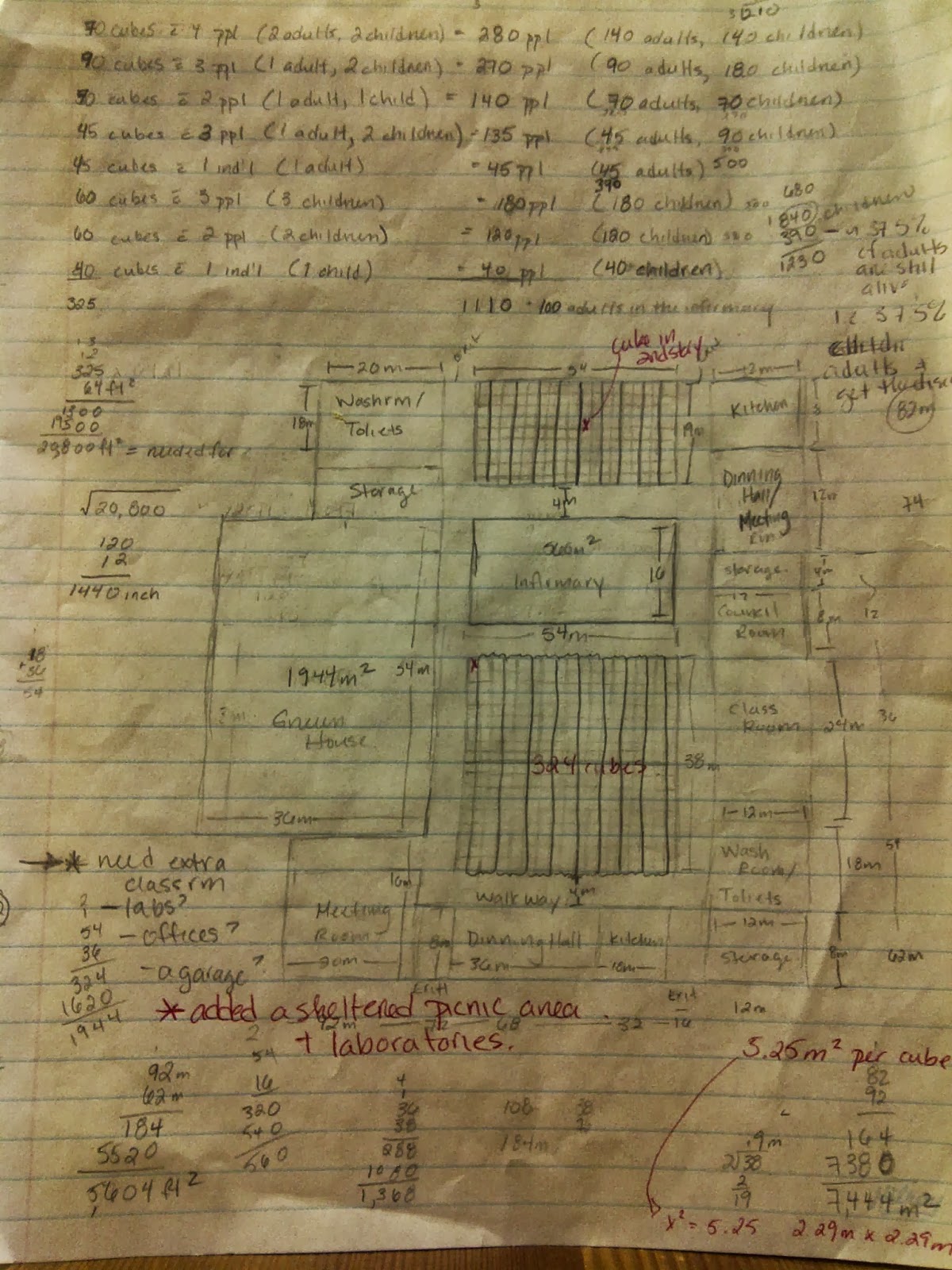 |
| The full page including my calculations for the number of people living in Nu Compound, and therefore how many cubes there needed to be. |
Andrea
Saturday, October 5, 2013
The Cure, Q&A: The Idea
I always have ideas flittering around in my head. (I have a back log of them right now, but I hope that since I'm now focused on finishing up Nora, that I will get to something new soon.) Sometimes the ideas are just a 'theme' (I want to do something steampunk-ish), or I have a character in mind (I want to write about a girl with green hair, or I want to write about a girl who can fly). From there I ponder about the idea and I just keep going over it until I've come up with something I can work with.
I hate to admit it, but the basic idea for The Cure came from a dream. I hate to say it because famously that's how Stephenie Meyer came up with the premise for the Twilight series. It feels a little passe to say 'My story came to me in a dream', but I suppose that's how many people come up with their ideas (or they hit their heads on toilets, so I guess I'd prefer a non-violent form of inspiration). Then again, I have to credit Stephenie Meyer for getting me writing again after more than a year long hiatus, so maybe I shouldn't be so hard on her.
So, yes. I had this dream where I and a whole bunch of other people were living in a giant airplane hanger. I don't know why we were all living in the airplane hanger, we just were (hey, it was a dream, things don't have to make sense). Everyone had a little space to themselves blocked off by curtains and I was living on the end cube where I could watch people pass by as they went about their business. When I woke up, I thought a lot about the scene in The Muppets Take Manhattan, were they're living in the lockers at the bus terminal. I liked how everyone's locker was representative of their character and how they were all crammed in their together.

And that's how it started. I didn't have characters, I didn't have much of a plot, just the setting. Then I thought and I thought (often at the Edmonton Symphony), and eventually I'd woven myself a web that became the story.
Ciao,
Andrea
(p.s., if you still haven't purchased yourself a copy of The Cure, you can find it here, on Kobo)
I hate to admit it, but the basic idea for The Cure came from a dream. I hate to say it because famously that's how Stephenie Meyer came up with the premise for the Twilight series. It feels a little passe to say 'My story came to me in a dream', but I suppose that's how many people come up with their ideas (or they hit their heads on toilets, so I guess I'd prefer a non-violent form of inspiration). Then again, I have to credit Stephenie Meyer for getting me writing again after more than a year long hiatus, so maybe I shouldn't be so hard on her.
So, yes. I had this dream where I and a whole bunch of other people were living in a giant airplane hanger. I don't know why we were all living in the airplane hanger, we just were (hey, it was a dream, things don't have to make sense). Everyone had a little space to themselves blocked off by curtains and I was living on the end cube where I could watch people pass by as they went about their business. When I woke up, I thought a lot about the scene in The Muppets Take Manhattan, were they're living in the lockers at the bus terminal. I liked how everyone's locker was representative of their character and how they were all crammed in their together.

And that's how it started. I didn't have characters, I didn't have much of a plot, just the setting. Then I thought and I thought (often at the Edmonton Symphony), and eventually I'd woven myself a web that became the story.
Ciao,
Andrea
(p.s., if you still haven't purchased yourself a copy of The Cure, you can find it here, on Kobo)
Wednesday, October 2, 2013
The Cure: Available on Kobo

Ciao,
Andrea
Wednesday, September 25, 2013
My venture into self-publishing: obtaining an ISBN
When I first decided to release The Cure, I hadn't considered the possibility of obtaining an ISBN (International Standard Book Number). It's not required by most online retailers (some provide an in-house ISBN or other identification number) and I'd thought it was one of those things that would be too difficult for a self-publisher to get. Not so! It's especially easy if you're Canadian, but first, what is an ISBN and why get it?
As per the Wikipedia page on ISBNs:
"The International Standard Book Number (ISBN) is a unique numeric commercial book identifier based upon the 9-digit Standard Book Numbering (SBN) code created by Gordon Foster, Emeritus Professor of Statistics at Trinity College, Dublin, for the booksellers and stationers W. H. Smith and others in 1965.
The 10-digit ISBN format was developed by the International Organization for Standardization (ISO) and was published in 1970 as international standard ISO 2108.
Since 1 January 2007, ISBNs have contained 13 digits, a format that is compatible with "Bookland" EAN-13s."
My understanding is that ISBNs are mostly important for brick and mortar bookstores so they can keep an accurate account of their stock (i.e. taking orders, making sales, etc). This is probably why ISBNs aren't required for digital books. There isn't really a stock, or at least, there's no physical product changing hands. Why it can be useful for independent publishers is that it can help boost visibility in the vast market of online books. You can also search a book by it's ISBN (although who's going to search for an ISBN over a title or author I don't know).
So, if you're a Canadian resident, ISBNs are free of charge, which is awesome, since if you're an American resident you have to pay for it.
Canadian residents go to Collections Canada, which is a part of Library and Archives of Canada. Once there, you click on the 'Join CISS' link on the left hand side. Next, click on the 'Acceptance of Terms', link and then you're taken to the electronic form you're required to fill out to obtain an account. It's a pretty straightforward form, requesting standard information. The one funny thing is, if you're planning to publish a digital book like I am, you select the Electronic Book Text option under 'Type of Product' (It sounds like a very archaic way of describing a digital book).
I waited around 10 days (I can't remember exactly what day I hit submit on) before I received an email to state my application had been accepted. From here, you have to go back to the CISS website, log in, and go to the 'Request an ISBN' link. At this point you just need to fill out one more form (again, very basic) and click submit. You'll have your ISBN almost immediately.
The ISBN for The Cure is: 978-0-9921294-0-8. It should be on sale very soon.
Ciao,
Andrea
As per the Wikipedia page on ISBNs:
"The International Standard Book Number (ISBN) is a unique numeric commercial book identifier based upon the 9-digit Standard Book Numbering (SBN) code created by Gordon Foster, Emeritus Professor of Statistics at Trinity College, Dublin, for the booksellers and stationers W. H. Smith and others in 1965.
The 10-digit ISBN format was developed by the International Organization for Standardization (ISO) and was published in 1970 as international standard ISO 2108.
Since 1 January 2007, ISBNs have contained 13 digits, a format that is compatible with "Bookland" EAN-13s."
My understanding is that ISBNs are mostly important for brick and mortar bookstores so they can keep an accurate account of their stock (i.e. taking orders, making sales, etc). This is probably why ISBNs aren't required for digital books. There isn't really a stock, or at least, there's no physical product changing hands. Why it can be useful for independent publishers is that it can help boost visibility in the vast market of online books. You can also search a book by it's ISBN (although who's going to search for an ISBN over a title or author I don't know).
So, if you're a Canadian resident, ISBNs are free of charge, which is awesome, since if you're an American resident you have to pay for it.
Canadian residents go to Collections Canada, which is a part of Library and Archives of Canada. Once there, you click on the 'Join CISS' link on the left hand side. Next, click on the 'Acceptance of Terms', link and then you're taken to the electronic form you're required to fill out to obtain an account. It's a pretty straightforward form, requesting standard information. The one funny thing is, if you're planning to publish a digital book like I am, you select the Electronic Book Text option under 'Type of Product' (It sounds like a very archaic way of describing a digital book).
I waited around 10 days (I can't remember exactly what day I hit submit on) before I received an email to state my application had been accepted. From here, you have to go back to the CISS website, log in, and go to the 'Request an ISBN' link. At this point you just need to fill out one more form (again, very basic) and click submit. You'll have your ISBN almost immediately.
The ISBN for The Cure is: 978-0-9921294-0-8. It should be on sale very soon.
Ciao,
Andrea
Thursday, September 12, 2013
My venture into self-publishing: picking retailers
I had hoped to have The Cure out for sale by now, but things will be postponed for a couple more days at least. I'm taking an online course on self-publishing offered by Author E.M.S., which runs from September 8th to October 4th. I'd been wondering before I started the course as to whether or not I should delay publishing until after I'd completed the session (I have so much to learn!). After the first day of reading, I was feeling overwhelmed with all there was to cover and was pretty sure that I ought to read through at least a few lessons before I plunged in.
**The moderator of the online course I'm taking just popped up on the discussion board to make an important distinction between publisher v. retailer. Amazon, Kobo, Barnes and Nobles, etc., are all retailers. They aren't publishers, they just distribute my work. That's the thing about self-publishing, YOU'RE THE PUBLISHER! I have to promote and protect my own novel.**
Part of my concern was what to do in regards to tax claims on Amazon. The way I understand it is, that although I don't have to pay American taxes, I need an International Taxpayer's Identification Number (ITIN) in order to get paid. Additionally, I'm subject to a withholding tax on any royalties I make, unless I show that I'm from a country that has a tax treaty with the US. I'm actually lucky here, since I'm currently residing in the US and have a visa, my route to an ITIN may be easier than if I was living in Canada. I'm still being paid by a Canadian company, by the way, which is why I currently don't have any other reasons to interact with the IRS.
If you're looking for information on how to get an ITIN, you can check out this blog post by Joan Leacott.
So, that was one of my big concerns about rushing ahead into publishing on Amazon. The other was, how on earth to price my novel, but that's more easily overcome with a little market research.
Something that came to my attention during my first course reading was, why hadn't I thought of publishing on Kobo Writing Life, a Canadian company? I'd been focused on Amazon's Kindle Direct, assuming that since Amazon was so huge, it was the best way to go, but considering the difficulties surrounding the payment and tax issues, why not go with Kobo, at least to start?
To be clear, I don't want to publish with only one company, and there's no need for me to publish with only one (although depending on which program I sign up with on Amazon, I may have to agree to an exclusivity period). In order to gain exposure and make sales, I need to get on as many different platforms as possible. My current intention is to get onto Kobo as soon as I get my ISBN (maybe I'll post about that another day...), meanwhile I'll begin the steps towards obtaining my ITIN. Once that comes through, I'll publish on Amazon. After that, we'll see. There are lots of other companies to self-publish on. It's just a matter of how diverse do I want to get/have the time for.
Ciao,
Andrea
**The moderator of the online course I'm taking just popped up on the discussion board to make an important distinction between publisher v. retailer. Amazon, Kobo, Barnes and Nobles, etc., are all retailers. They aren't publishers, they just distribute my work. That's the thing about self-publishing, YOU'RE THE PUBLISHER! I have to promote and protect my own novel.**
Part of my concern was what to do in regards to tax claims on Amazon. The way I understand it is, that although I don't have to pay American taxes, I need an International Taxpayer's Identification Number (ITIN) in order to get paid. Additionally, I'm subject to a withholding tax on any royalties I make, unless I show that I'm from a country that has a tax treaty with the US. I'm actually lucky here, since I'm currently residing in the US and have a visa, my route to an ITIN may be easier than if I was living in Canada. I'm still being paid by a Canadian company, by the way, which is why I currently don't have any other reasons to interact with the IRS.
If you're looking for information on how to get an ITIN, you can check out this blog post by Joan Leacott.
So, that was one of my big concerns about rushing ahead into publishing on Amazon. The other was, how on earth to price my novel, but that's more easily overcome with a little market research.
Something that came to my attention during my first course reading was, why hadn't I thought of publishing on Kobo Writing Life, a Canadian company? I'd been focused on Amazon's Kindle Direct, assuming that since Amazon was so huge, it was the best way to go, but considering the difficulties surrounding the payment and tax issues, why not go with Kobo, at least to start?
To be clear, I don't want to publish with only one company, and there's no need for me to publish with only one (although depending on which program I sign up with on Amazon, I may have to agree to an exclusivity period). In order to gain exposure and make sales, I need to get on as many different platforms as possible. My current intention is to get onto Kobo as soon as I get my ISBN (maybe I'll post about that another day...), meanwhile I'll begin the steps towards obtaining my ITIN. Once that comes through, I'll publish on Amazon. After that, we'll see. There are lots of other companies to self-publish on. It's just a matter of how diverse do I want to get/have the time for.
Ciao,
Andrea
Thursday, September 5, 2013
My venture into self-publishing: the editing
Although I felt that The Cure was fairly well edited, I wanted to get someone with a more professional eye (than my friends and husband) to look over my novel before I put it up for sale on Amazon. As always, I was concerned about the grammar aspect, but I wanted to make sure the story and characters made sense as well. I figured, even through I couldn't get a proper publisher to release it, I still wanted it to be as polished as possible.
So, I hired an editor. I was given a name or someone, whom I contacted, was given a quote, and a time frame. Unfortunately that experience didn't work out as well as I had hoped. I had to nag to get chapters back and although the responses were generally quick (after I nagged), the excuses almost became comical after a while. The comments in the manuscript felt sarcastic at times (it's not cool to use ALL CAPS, or smiley faces like you're joking) and almost like the editor was lecturing me for having not corrected errors from the last time I made them (never mind that I sent my manuscript to them all at once). Eventually, I ended up in tears one night somewhere in the middle of chapter 12 and decided that enough was enough.
I either had to battle massive self-doubt for the remaining chapters as I worked through edits, or I had to find someone else to look through the end of the manuscript.
Then it occurred to me that my sister-in-law might be able to help. I recalled that she'd done some freelance editing, and that she'd trying to organize a story-share one time which I participated. So, I sent an email, explained my situations, and thankfully, she agreed. I'll do another post of about her editing later. It's a part of our deal. She provided me with an important service and I'm going to write her a testimonial on my blog.
For now, I'll just say that I'm extremely grateful. I'm back up to where I left off with the other editor (yeah, she went through the whole manuscript from the start for me) and I hope to have it wrapped up by the end of the week. Yeah. I hope to have the whole thing wrapped up in just a few days. It seems a little crazy now that I'm writing this. Wrapped up, and out there for people to buy. I just hope a few people buy it, and at least some of them enjoy it and look forward to seeing the second story.
For now, I need to get on with the editing, so I can indeed have it on the cyber shelves within a week or two.
Ciao
So, I hired an editor. I was given a name or someone, whom I contacted, was given a quote, and a time frame. Unfortunately that experience didn't work out as well as I had hoped. I had to nag to get chapters back and although the responses were generally quick (after I nagged), the excuses almost became comical after a while. The comments in the manuscript felt sarcastic at times (it's not cool to use ALL CAPS, or smiley faces like you're joking) and almost like the editor was lecturing me for having not corrected errors from the last time I made them (never mind that I sent my manuscript to them all at once). Eventually, I ended up in tears one night somewhere in the middle of chapter 12 and decided that enough was enough.
I either had to battle massive self-doubt for the remaining chapters as I worked through edits, or I had to find someone else to look through the end of the manuscript.
Then it occurred to me that my sister-in-law might be able to help. I recalled that she'd done some freelance editing, and that she'd trying to organize a story-share one time which I participated. So, I sent an email, explained my situations, and thankfully, she agreed. I'll do another post of about her editing later. It's a part of our deal. She provided me with an important service and I'm going to write her a testimonial on my blog.
For now, I'll just say that I'm extremely grateful. I'm back up to where I left off with the other editor (yeah, she went through the whole manuscript from the start for me) and I hope to have it wrapped up by the end of the week. Yeah. I hope to have the whole thing wrapped up in just a few days. It seems a little crazy now that I'm writing this. Wrapped up, and out there for people to buy. I just hope a few people buy it, and at least some of them enjoy it and look forward to seeing the second story.
For now, I need to get on with the editing, so I can indeed have it on the cyber shelves within a week or two.
Ciao
Monday, August 26, 2013
My venture into self-publishing: my cover
One of the steps involved in self-publishing is getting/developing/creating cover art. You need something to catch the eye of a browser, right? Because people really do judge books by their covers.
When it came to thinking about my art, I knew I didn't possess the skills to create something cool, so I contacted a friend of mine, Anna Krider, who has tons of skillz in graphic design. To see her work, you can check out her website: Peach Pants Press.
I didn't have any particular ideas of what I wanted my cover to look like, I just wanted it to look "professional." After a little back and forth, Anna created something funky and abstract. I like the sparkly bits throughout the body, plus she used some nifty layering techniques (that I can't tell you about because it's actually spoiler related!). Anywho, here's my cover:

Now I have a super awesome cover, and I got to employ the skills of a friend. Two birds down with one stone, I'd say.
Cheers,
When it came to thinking about my art, I knew I didn't possess the skills to create something cool, so I contacted a friend of mine, Anna Krider, who has tons of skillz in graphic design. To see her work, you can check out her website: Peach Pants Press.
I didn't have any particular ideas of what I wanted my cover to look like, I just wanted it to look "professional." After a little back and forth, Anna created something funky and abstract. I like the sparkly bits throughout the body, plus she used some nifty layering techniques (that I can't tell you about because it's actually spoiler related!). Anywho, here's my cover:

Now I have a super awesome cover, and I got to employ the skills of a friend. Two birds down with one stone, I'd say.
Cheers,
Thursday, August 15, 2013
My venture into self-publishing: the why
I haven't looked back over my blog posts to see how many times I've said I wasn't going to self-publish. It's probably been more than once, or twice, or...enough times, anyways. Sometimes I feel like I have no constancy. I tend to run with an idea for a while, while it's exciting and new, but once things aren't going so smoothly, or they're taking too long and the excitement wanes, I change my mind, or perhaps more accurately, I just give up.
So, what's changed this time around?
Back in April, around my birthday, I was exchanging messages with a friend. A friend who I contact whenever I need publishing advice, usually when I get a hint of success (I've had 2 different publishing companies interested in my work, one for Nora, one for Ava, but they've both fallen through). When we were talking this time, she mentioned that she had released some work through the Amazon Kindle Select program. I'd already released Nora here on my blog, but it hadn't gotten a large readership, and so I got to thinking.
It still might not get a large readership on Amazon, but would it hurt? It couldn't hurt. Right?
E, self-publishing is popular. Occasionally authors see a great deal of success--not that I'm expecting big numbers and big money--but authors are also seeing decent success. With the Amazon Kindle Select program anyone can publish with it (although there are some rules about what type of material can be published) and editing isn't required (although I hired an editor to go through the manuscript). The royalties are also much better with an e-book than a print book, which is a plus--assuming I can get people to buy mine.
And so I hope to have The Cure available early to mid September. This isn't exactly how I'd always dreamed of making my publishing debut, I've clung to the idea of being traditionally published for a long time, but at least for Nora, it's the only way she's going to see a wide release. I feel that I've racked up enough rejections with her to have to take the hint that no one's interested. I'm still going to query agents and editors with my other series Cimwai's Bay, but who knows, maybe if Nora does well, I might try the same thing with Ava.
So does has this post answered the why?
If not, feel free to ask a question, although as I note, I moderate the comments, so it won't show up immediately.
Ciao,
Andrea
So, what's changed this time around?
Back in April, around my birthday, I was exchanging messages with a friend. A friend who I contact whenever I need publishing advice, usually when I get a hint of success (I've had 2 different publishing companies interested in my work, one for Nora, one for Ava, but they've both fallen through). When we were talking this time, she mentioned that she had released some work through the Amazon Kindle Select program. I'd already released Nora here on my blog, but it hadn't gotten a large readership, and so I got to thinking.
It still might not get a large readership on Amazon, but would it hurt? It couldn't hurt. Right?
E, self-publishing is popular. Occasionally authors see a great deal of success--not that I'm expecting big numbers and big money--but authors are also seeing decent success. With the Amazon Kindle Select program anyone can publish with it (although there are some rules about what type of material can be published) and editing isn't required (although I hired an editor to go through the manuscript). The royalties are also much better with an e-book than a print book, which is a plus--assuming I can get people to buy mine.
And so I hope to have The Cure available early to mid September. This isn't exactly how I'd always dreamed of making my publishing debut, I've clung to the idea of being traditionally published for a long time, but at least for Nora, it's the only way she's going to see a wide release. I feel that I've racked up enough rejections with her to have to take the hint that no one's interested. I'm still going to query agents and editors with my other series Cimwai's Bay, but who knows, maybe if Nora does well, I might try the same thing with Ava.
So does has this post answered the why?
If not, feel free to ask a question, although as I note, I moderate the comments, so it won't show up immediately.
Ciao,
Andrea
Monday, June 11, 2012
Goodnight, sweet Nora, it's time to go
So I fell off the blogging wagon. I just having felt much like keeping things up-to-date this year. I've been feeling busy and frazzled, and frankly not much like regular writing either. That's the problem with having a job that requires brain-power all day, it frequently leaves me spent by the time I get home. Despite my best efforts, I've been pretty unproductive all around. Hrm. I'm not sure I can honestly say I've put my best efforts into things either, there's been plenty of nights where I've blown off writing or barely made an effort. Where did all my focus go? When I was still just an RA I could pretty easily put an entire night into writing, at least 3 hours, get a minimum of 2,000 words written. Now I'm lucky if I get 1,300. Yesh.
On a related note, I recently received another rejection letter for Nora. She's been to at least a dozen agents and five or six publishers who actually accept unsolicited manuscripts. I fear it's time to put her to bed; that she is unpublishable; that I write too sweetly for YA lit these days. I've had a few people suggest that I should try self-publishing. I'm pretty sure I've written about my reservations regarding self-publishing here before. On top of my concerns that it's not a truly accepted form of publishing (i.e. I think most people still look down on self-publishing as a way for untalented writers to get their books out), I also completely lack a sufficient social network to turn a profit. My circle of acquaintances are small, and I don't feel comfortable talking about my work to about 95% of them, let alone try to market/advertise my book to them.
I don't know what to do. I've considered just posting the manuscript here, a few pages at a time every week or maybe twice a week. Of course, posting Nora here, freely, with little-to-no exposure doesn't really seem like a great plan either, but I don't have to pay anything to do this (self-publishing isn't free from what I've seen). She's reasonably well edited, and complete. Maybe a few people with stumble upon her. It would at the very least be better than letting her waste away unread and unloved on my computer hard drive. I could cross my fingers and hope some editor somewhere will stumble upon her, but I doubt that's likely to happen either.
I should probably make a few changes to the title and description of my blog, but expect to see chapters of Nora appear here soon--unless somebody out there has a great alternative suggestion for what I can do.
Ciao,
Andrea
On a related note, I recently received another rejection letter for Nora. She's been to at least a dozen agents and five or six publishers who actually accept unsolicited manuscripts. I fear it's time to put her to bed; that she is unpublishable; that I write too sweetly for YA lit these days. I've had a few people suggest that I should try self-publishing. I'm pretty sure I've written about my reservations regarding self-publishing here before. On top of my concerns that it's not a truly accepted form of publishing (i.e. I think most people still look down on self-publishing as a way for untalented writers to get their books out), I also completely lack a sufficient social network to turn a profit. My circle of acquaintances are small, and I don't feel comfortable talking about my work to about 95% of them, let alone try to market/advertise my book to them.
I don't know what to do. I've considered just posting the manuscript here, a few pages at a time every week or maybe twice a week. Of course, posting Nora here, freely, with little-to-no exposure doesn't really seem like a great plan either, but I don't have to pay anything to do this (self-publishing isn't free from what I've seen). She's reasonably well edited, and complete. Maybe a few people with stumble upon her. It would at the very least be better than letting her waste away unread and unloved on my computer hard drive. I could cross my fingers and hope some editor somewhere will stumble upon her, but I doubt that's likely to happen either.
I should probably make a few changes to the title and description of my blog, but expect to see chapters of Nora appear here soon--unless somebody out there has a great alternative suggestion for what I can do.
Ciao,
Andrea
Thursday, August 11, 2011
Book review: two very different young adult novels
I don't often review books on my blog, but I thought during the summer lull I might take on the task. The two books I plan to focus on are both young adult (YA) novels, the main characters are both 16 years old, and I read them both on my trip to Pittsburgh, but that's where the similarities end. I was also originally made aware of both of these books through two of my favourite blogs, but again these blogs are very different.
First, Spoiled by Heather Cocks and Jessica Morgan, the witty webmistresses of www.gofugyourself.com, which is of course where I heard about their book. Spoiled, is a fun and flirty read, which zips by without any trouble whatsoever. The tone of the book is reminiscent of the style of their blog, right down to their comments on fashions, celebrities and celebrity life. I fear the referencing to clothing, designers, actors and actresses might date the book quickly, but it could also serve as an amusing snap shot into popular culture of the 2010's. The plot is somewhat standard in it's course: two half-sisters brought together for the first time after the death of Molly's (the common-place mid-west born sister) mother. Brook (the LA glamour-girl sister) takes none-to-kind to having her territory invaded and a war of wits ensues.
Even if the storyline isn't original, it's no reason not to enjoy the book. The story is told primary from Molly's perspective (although some chapters are in Brook's PoV) and I immediately found her to be a smart, likable character. It was easy to sympathize with her over her difficulty of fitting in with the high-society of her new school and I couldn't help but root for the cute, understanding boy who popped up to make things a little more bearable for her. Also, the girls' father, Brick Berlin, is a riot. He's constantly on the phone with some agent or producer, struck with absurd movie ideas at random, and makes air-headed attempts at providing words of wisdom to his two daughters. The book doesn't, in fact, end all roses, which I kind of prefer, and it leaves things open for the sequel, Messy.
Since I completed three-quarter of Spoiled on the plane, then finished it the first night in Pittsburgh, I needed something different to read on the way home. When I wandered into the Hudsons in the Pittsburgh Airport I didn't have a particular title in mind, but when I saw Miss Peregrine's Home for Peculiar Children I decided to pick it up based on the recommendation of Jenn from www.epbot.com (she also writes Cake Wrecks). Actually, I had a short debate between Miss Peregrine's and the first novel in the Hunger Games series, both sounded intriguing, but after reading the first page of each I went with Miss Peregrine's since it seemed to have some link to WWII.
Miss Peregrine's is a considerably different read from Spoiled. The protagonist is a boy, it's more in the speculative fiction/fantasy realm and has a considerably more dark and mysterious tone. The story is about Jacob, a present day boy, born to a wealthy family, who doesn't quite fit in. He has a grandfather who used to tell him fantastical stories about his 'gifted' friends until eventually Jacob (primarily due to growing up) stops believing in them. As the grandfather gets older, he grows paranoid and seemingly delusional--only the monsters he sees are real, and one of them kills him right in front of Jacob. As you might imagine, this event spirals Jacob into a desparate situation where he winds up in therapy and eventually manages to convince his parents he needs to go to the island where his grandfather took shelter during the war.
The island is an obscure little place off the coast of Wales, I think, (I don't remember for sure), it's tiny, there's only one phone on the whole island, and one rentable room too. I can't go into many more details without spoiling the story, but Jacob succeeds in finding the hiding place of his grandfather's 'gifted' friend, still the same age as in the snapshots he was shown as a boy. I liked the story, there were a couple of good twists, and a hanging ending, which definitely indicates another book to come. The 'gifted' friends were an interesting concept, although there were so many I had trouble keeping track of who was who outside the main three or four. Each new character was introduced with a vintage photo, an interesting idea, but after a while I found it redundant to read, 'and Miss Peregrine had a photo...' (or whatever the line was). I also found the swearing a little much for my preference in a YA novel, but maybe that's my own prudishness coming out.
At any rate, I would recommend both of these books, although not necessarily to the same reader--unless like me you like a wide range of genres in your reading material. Spoiled is just plain fun, whereas Miss Peregrine's has a more unique idea behind it.
Ciao,
Andrea
First, Spoiled by Heather Cocks and Jessica Morgan, the witty webmistresses of www.gofugyourself.com, which is of course where I heard about their book. Spoiled, is a fun and flirty read, which zips by without any trouble whatsoever. The tone of the book is reminiscent of the style of their blog, right down to their comments on fashions, celebrities and celebrity life. I fear the referencing to clothing, designers, actors and actresses might date the book quickly, but it could also serve as an amusing snap shot into popular culture of the 2010's. The plot is somewhat standard in it's course: two half-sisters brought together for the first time after the death of Molly's (the common-place mid-west born sister) mother. Brook (the LA glamour-girl sister) takes none-to-kind to having her territory invaded and a war of wits ensues.
Even if the storyline isn't original, it's no reason not to enjoy the book. The story is told primary from Molly's perspective (although some chapters are in Brook's PoV) and I immediately found her to be a smart, likable character. It was easy to sympathize with her over her difficulty of fitting in with the high-society of her new school and I couldn't help but root for the cute, understanding boy who popped up to make things a little more bearable for her. Also, the girls' father, Brick Berlin, is a riot. He's constantly on the phone with some agent or producer, struck with absurd movie ideas at random, and makes air-headed attempts at providing words of wisdom to his two daughters. The book doesn't, in fact, end all roses, which I kind of prefer, and it leaves things open for the sequel, Messy.
Since I completed three-quarter of Spoiled on the plane, then finished it the first night in Pittsburgh, I needed something different to read on the way home. When I wandered into the Hudsons in the Pittsburgh Airport I didn't have a particular title in mind, but when I saw Miss Peregrine's Home for Peculiar Children I decided to pick it up based on the recommendation of Jenn from www.epbot.com (she also writes Cake Wrecks). Actually, I had a short debate between Miss Peregrine's and the first novel in the Hunger Games series, both sounded intriguing, but after reading the first page of each I went with Miss Peregrine's since it seemed to have some link to WWII.
Miss Peregrine's is a considerably different read from Spoiled. The protagonist is a boy, it's more in the speculative fiction/fantasy realm and has a considerably more dark and mysterious tone. The story is about Jacob, a present day boy, born to a wealthy family, who doesn't quite fit in. He has a grandfather who used to tell him fantastical stories about his 'gifted' friends until eventually Jacob (primarily due to growing up) stops believing in them. As the grandfather gets older, he grows paranoid and seemingly delusional--only the monsters he sees are real, and one of them kills him right in front of Jacob. As you might imagine, this event spirals Jacob into a desparate situation where he winds up in therapy and eventually manages to convince his parents he needs to go to the island where his grandfather took shelter during the war.
The island is an obscure little place off the coast of Wales, I think, (I don't remember for sure), it's tiny, there's only one phone on the whole island, and one rentable room too. I can't go into many more details without spoiling the story, but Jacob succeeds in finding the hiding place of his grandfather's 'gifted' friend, still the same age as in the snapshots he was shown as a boy. I liked the story, there were a couple of good twists, and a hanging ending, which definitely indicates another book to come. The 'gifted' friends were an interesting concept, although there were so many I had trouble keeping track of who was who outside the main three or four. Each new character was introduced with a vintage photo, an interesting idea, but after a while I found it redundant to read, 'and Miss Peregrine had a photo...' (or whatever the line was). I also found the swearing a little much for my preference in a YA novel, but maybe that's my own prudishness coming out.
At any rate, I would recommend both of these books, although not necessarily to the same reader--unless like me you like a wide range of genres in your reading material. Spoiled is just plain fun, whereas Miss Peregrine's has a more unique idea behind it.
Ciao,
Andrea
Tuesday, July 13, 2010
The post I forgot to title*
Since we haven't had quite enough growth in our garden to warrant an update, and it's the middle of the summer and I'm not up to much, I thought I might compose another post on writing. This will not be a post of tips and trick as I haven't actually managed to achieve publication, and I also failed to complete the popular fiction writing program at Seton Hill. Nor will it be a lesson on spelling and grammar, as although my technical writing abilities are better than they once were, they are still far from pristine. Instead, I thought I might take a few minutes to reflect upon the process of writing.
First and foremost, writing requires time--lots of time. I think this may be the biggest aspect of writing that the average person tends to overlook. Since I work full-time during the day, I need as many of my evening hours free to devote to writing. That means, if you invite me out to a movie or some other event from Monday to Thursday I am likely to hesitate, probably give you a look of pain, and then politely decline. It's not that I don't want to hang out and have fun, but for me it means that I'll miss out on 3 to 3.5 hours of writing time if I choose to go out. If I'm in the middle of the writing process, that roughly translates into somewhere between 9 and 15 pages that don't get written, or if editing between 24 to 36 pages that don't get read. I also start to feel crappy when I miss too many writing opportunities. It might seem strange to say, but writing is a part of who I am, and so when I don't get to it (like when I was in school) I start to struggle in life.
Now, what's my second point? Do I have second point? A second point...I suppose another question some non-writing people might wonder about is where do the story ideas come from and how do you manage plot. I imagine the answer to this is different for every writer. For me, ideas can come from almost anywhere. I've had several dreams (yes, Stephenie Meyer isn't the only one) that have sparked ideas. Usually it's only a small portion or aspect of the dream that will lead to a bigger idea, not the entire dream itself as mine tend to be very disjointed. The concept, or really just the setting for Nora came from a dream where I lived in a giant plane hanger broken down into cubicles with hundreds of other people. Sometimes I have vague ideas like, wouldn't it be fun to write a manuscript about a person who can fly? I think upon the idea (usually while at the ESO) and eventually a character and their story will work their way out.
Managing plot can be difficult, and historically, I'm not very good at it. Often I've simply written on the fly and whatever pops into my head at the moment is what I write. For both the first and second installments of Nora's story I've worked with a loose framework, knowing where the story needed to end up, but not entirely sure how it was going to get there. Keeping track of what you've laid down as fact in a manuscript can also be difficult (and a good reason to plan a head). Again, I've had mixed attempts at maintaining control of my worlds. When writing on the fly I usually end up scrolling through my manuscript searching for items or issues I've referenced before to see what I did. I've also tried to use recipe cards to track things. Presently I'm making use of wiki technology (PBWorks) to track plot, characters, and other random bits of information in The Cause.
Not everyone who writes wants to get published. Some people (like poor old George McFly) fear rejection, worry that people won't like what they've written and prefer to keep their work to themselves. I do want to publish. If I created a "Bucket List" I would have three items on it: 1) Publish a novel, 2) Walk on the great wall of China, and 3) Visit a rain forest (in South America). I don't expect success--at least not on the J.K. Rowling-scale. If I could get to the point where I don't have to work full-time to maintain a comfortable lifestyle (owning my own home, a car, etc) I'd be happy, but...lots of people want to be writers. Agents and editors are overwhelmed with want-to-be-writers and it's simply not possible (nor desirable, frankly) for every manuscript sent their way to be published. At present I'm looking for a literary agent, since once you get one of those, getting a publication contract becomes easier (i.e. your work won't rotting away in the slush pile).
Cross you fingers for me, if you can spare to, or say a prayer if you prefer. It may take all the determination I have to achieve this goal, then I can look into China (maybe I can find a bored child to dig me a tunnel during the summer holidays...).
Ciao,
Andrea
btw, I actually do have a few publications to my name. They're scholarly papers (the amount of writing I did for them is minimal) so I don't really count them, but if you have access to these journals you can check them out:
Hartling L, Milne A, Tjosvold L, Wrightson D, Gallivan J, Newton N. A systematic review of interventions to support siblings of children with chronic illness or disability. J Paediatr Child Health. [In Press]
Couch R, Jetha M, Dryden DM, Hooten N, Liang Y, Durec T, Sumamo E, Spooner C, Milne A, O'Gorman K, Klassen TP. Diabetes education for children with type 1 diabetes mellitus and their families. Evid Rep Technol Assess (Full Rep). 2008 Apr;(166):1-144.
*Whoops. Forgot to come up with a witty title when I first published this post.
First and foremost, writing requires time--lots of time. I think this may be the biggest aspect of writing that the average person tends to overlook. Since I work full-time during the day, I need as many of my evening hours free to devote to writing. That means, if you invite me out to a movie or some other event from Monday to Thursday I am likely to hesitate, probably give you a look of pain, and then politely decline. It's not that I don't want to hang out and have fun, but for me it means that I'll miss out on 3 to 3.5 hours of writing time if I choose to go out. If I'm in the middle of the writing process, that roughly translates into somewhere between 9 and 15 pages that don't get written, or if editing between 24 to 36 pages that don't get read. I also start to feel crappy when I miss too many writing opportunities. It might seem strange to say, but writing is a part of who I am, and so when I don't get to it (like when I was in school) I start to struggle in life.
Now, what's my second point? Do I have second point? A second point...I suppose another question some non-writing people might wonder about is where do the story ideas come from and how do you manage plot. I imagine the answer to this is different for every writer. For me, ideas can come from almost anywhere. I've had several dreams (yes, Stephenie Meyer isn't the only one) that have sparked ideas. Usually it's only a small portion or aspect of the dream that will lead to a bigger idea, not the entire dream itself as mine tend to be very disjointed. The concept, or really just the setting for Nora came from a dream where I lived in a giant plane hanger broken down into cubicles with hundreds of other people. Sometimes I have vague ideas like, wouldn't it be fun to write a manuscript about a person who can fly? I think upon the idea (usually while at the ESO) and eventually a character and their story will work their way out.
Managing plot can be difficult, and historically, I'm not very good at it. Often I've simply written on the fly and whatever pops into my head at the moment is what I write. For both the first and second installments of Nora's story I've worked with a loose framework, knowing where the story needed to end up, but not entirely sure how it was going to get there. Keeping track of what you've laid down as fact in a manuscript can also be difficult (and a good reason to plan a head). Again, I've had mixed attempts at maintaining control of my worlds. When writing on the fly I usually end up scrolling through my manuscript searching for items or issues I've referenced before to see what I did. I've also tried to use recipe cards to track things. Presently I'm making use of wiki technology (PBWorks) to track plot, characters, and other random bits of information in The Cause.
Not everyone who writes wants to get published. Some people (like poor old George McFly) fear rejection, worry that people won't like what they've written and prefer to keep their work to themselves. I do want to publish. If I created a "Bucket List" I would have three items on it: 1) Publish a novel, 2) Walk on the great wall of China, and 3) Visit a rain forest (in South America). I don't expect success--at least not on the J.K. Rowling-scale. If I could get to the point where I don't have to work full-time to maintain a comfortable lifestyle (owning my own home, a car, etc) I'd be happy, but...lots of people want to be writers. Agents and editors are overwhelmed with want-to-be-writers and it's simply not possible (nor desirable, frankly) for every manuscript sent their way to be published. At present I'm looking for a literary agent, since once you get one of those, getting a publication contract becomes easier (i.e. your work won't rotting away in the slush pile).
Cross you fingers for me, if you can spare to, or say a prayer if you prefer. It may take all the determination I have to achieve this goal, then I can look into China (maybe I can find a bored child to dig me a tunnel during the summer holidays...).
Ciao,
Andrea
btw, I actually do have a few publications to my name. They're scholarly papers (the amount of writing I did for them is minimal) so I don't really count them, but if you have access to these journals you can check them out:
Hartling L, Milne A, Tjosvold L, Wrightson D, Gallivan J, Newton N. A systematic review of interventions to support siblings of children with chronic illness or disability. J Paediatr Child Health. [In Press]
Couch R, Jetha M, Dryden DM, Hooten N, Liang Y, Durec T, Sumamo E, Spooner C, Milne A, O'Gorman K, Klassen TP. Diabetes education for children with type 1 diabetes mellitus and their families. Evid Rep Technol Assess (Full Rep). 2008 Apr;(166):1-144.
*Whoops. Forgot to come up with a witty title when I first published this post.
Saturday, July 3, 2010
Three young adult (YA) novels for review
A few weeks ago, as I sat down to work on my agent query letter, I decided I needed to do some market research reading before I could go any further. Rather, I came to the dreadful realization as I tried to write my letter that I couldn't actually name any resent YA fiction that was similar to my own work as advised to do on the potential agent's Website. In order to correct this problem I: 1) went to the EPL (Edmonton Public Library) Website to see if I could locate anything useful there; and 2) I jumped on Facebook and asked for suggestions (since I've just finished an MLIS I was pretty sure that some of my classmates would have some kind of idea of what's currently out there). I came up with three titles to try (after all, I didn't want to spend weeks and weeks reading when I wanted to move forward with my querying) and I thought I might give a brief review of them here.
Inside Out by Maria V. Synder.
Okay, so this one I actually knew about myself, but this exercise gave me the excuse to go buy it. I've got all of Maria's (yes, I refer to Maria by her first name, although we barely know each other) on my shelf, so I knew I had to try her new YA title. As I began to read the atmosphere of Inside Out reminded me of the movie The Island. A group of people are stuck in a monotonous existence, and there's a magical place called "Outside" where everyone wants to get to. It's not quite as simple as that, of course. Trella, is the story's lead character. She is a loner (as most heroes are, mine included) and wishes she wasn't wasting her life away in the lower levels as a scrub. She has one friend in the entire Inside, named Cog, who at the beginning of this story bags her to speak to the newest profit spouting nonsense about the existence of "Outside." She agrees just to get Cog off her back and that's where things start to spin out of control.
I won't give away more plot details in case anyone's interesting in checking it out for themselves. I highly enjoyed this book. I think I plowed through it over two nights. I was immediately interested in getting to know more about Trella and the unpleasant and confined world she was stuck in. I was a little surprised by the amount of violence that took place during the story, although most of it happened "off stage." It's definitely a read for older teens who can handle the thought of someone being tortured. Trella is smart, self-reliant, and confident, three things I like to see in figures for young girls, although she is fairly similar to Maria's other heroines Yelena and Opal. I also liked the different dynamics between the classes in this story, and the pre-conceived notions each character had to overcome. The couple of twists in the ending (one relationship-wise and one setting) were well hid (although Andrew guessed the one well before I did). I always feel like Maria has full command over her world and knows exactly how things work in it, which is something I rarely manage to achieve myself. One of my biggest complains is that sometimes the antagonists are conveniently willing to wait set periods of time before they act and therefore let Trella and her helpers accomplish what the need to, to defeat them. There's a second plot-related issue that Andrew brought up (being a mechanical engineer he also mentioned some technical issues, but I highly doubt that the main readership of this novel will notice), but it would be a spoiler to discuss here, so I won't. All in all, I would definitely recommend this book.
How I Live Now, by Meg Rosoff.
This book was suggested to me by a couple of different friends on Facebook, and later I received several "likes" when I posted I had begun to read it. Clearly this is a popular book. The unique voice in which this book is written is apparent immediately. The narrator is a fifteen year old girl named Daisy, and the use of run-on sentences (for entire paragraphs), and Random Capitalization, for me, completely captured the essence of a teenage girl telling her story. The stream of consciousness prose may annoy some readers. I outright told Andrew I didn't think he would like How I live Now, primarily for this reason. That, and there's virtually no dialogue as characters only speak through Daisy's narrative as she recounts the story (Andrew likes to make fun of some of Robin McKinley's novels because there's approximately one line of dialogue for every ten pages).
Okay, so what is this story about? It wasn't too sure what to expect when I started this book. I purchased it based solely on the fact that it had been recommended and endorsed by friends. I'm not sure I even really read the back "blurb" once it arrived from my local bookstore, I just dove right in. I'd say the backdrop of this story is war, but the real purpose is to highlight love and survival. As the novel opens, Daisy has just arrived in London from New York City, having requested to stay with her mother's family after her father remarries (her own mother having died giving birth to her). The atmosphere is tense with the prospect of an enemy attack at any moment. Reasons for the pending hostilities are never explained, and I don't think it's at that all necessary, as I said, the war is not the point. The point is Daisy meeting unconditional love from an aunt and cousins she's never met before her arrival in England. And then it's about what children (or people in general, really) will do to endure the experience of war. Again, I won't go any further and give away important plot points. I would recommend this book to almost anyone. I say almost, party because the voice is so unique it might throw some readers off. Also, mature issues are dealt with in the book including eating disorders, sex and violence. I think readers Daisy's age could handle this book, possibly a year or two younger as well, but it might require some thoughtful discussion with an adult figure.
The Line, by Teri Hall.
I located this book out of the EPL catalogue after searching for Inside Out then seeing what the catalogue recommended. Reading this book immediately after How I Live Now perhaps was not the best of ideas. The vast difference in prose styles was a mental shocker, going from a somewhat bubbly, chatty narrator to the slightly dryer voice of The Line. I expect I would have persevered to read this book even if it wasn't for market research, but getting through the first chapter or two was slow. Actually, reading The Line made me feel good in ways I'm not sure the author intend. Maria's book caused me disappear, because I felt that my manuscript was not sophisticated, or intricate enough. Teri Hall, however, is a first time author, and I could definitely pick out a number of first-timer mistakes/problems that reassured me that perhaps one day I might managed to get published too.
So, the bad first: I think I would have preferred a single point-of-view (PoV), and preferably the heroine, Rachel's, rather than the three, or four (I forget exactly how many) that were used. Although I didn't find the differing PoVs too distracting, I think young adult readers would prefer to stay with Rachel's interpretation of events and not jump into various adult character's voices. I also felt that the amount of exposition in the story was a little on the high side. I got the idea that Hall had I very clear vision of the world she'd created, but I also felt like too much time was spent on giving me a history lesson about it. Additionally, some readers may find these sections a bit on the preachy side (I think the author has a definite mission with this story), but it didn't bother me too much. Overall, however, I did enjoy this read. I was interested in the post-apocalyptic world, and how Rachel and her mother came to live on the Property. The title comes from the existence of a "line" (I'm not exactly sure whether it's electronic, electric, or other) that separates the United States from it's adversaries (being Canadian, I spent much of the book wondering if those enemies were my fellow countrymen, but there's no such indication). The plot of the story gets rolling when Rachel is tempted to try to cross the line, even though she knows it's considered risky/illegal. Eventually find she has to cross in order to help someone in distress on the other side. Again, I would recommend this book to readers who enjoy speculative fiction, they just may need to be more forgiving and patient than for those books listed above.
Now I must get back to editing my own YA, dystopian speculative fiction.
Ciao,
Andrea
Inside Out by Maria V. Synder.
Okay, so this one I actually knew about myself, but this exercise gave me the excuse to go buy it. I've got all of Maria's (yes, I refer to Maria by her first name, although we barely know each other) on my shelf, so I knew I had to try her new YA title. As I began to read the atmosphere of Inside Out reminded me of the movie The Island. A group of people are stuck in a monotonous existence, and there's a magical place called "Outside" where everyone wants to get to. It's not quite as simple as that, of course. Trella, is the story's lead character. She is a loner (as most heroes are, mine included) and wishes she wasn't wasting her life away in the lower levels as a scrub. She has one friend in the entire Inside, named Cog, who at the beginning of this story bags her to speak to the newest profit spouting nonsense about the existence of "Outside." She agrees just to get Cog off her back and that's where things start to spin out of control.
I won't give away more plot details in case anyone's interesting in checking it out for themselves. I highly enjoyed this book. I think I plowed through it over two nights. I was immediately interested in getting to know more about Trella and the unpleasant and confined world she was stuck in. I was a little surprised by the amount of violence that took place during the story, although most of it happened "off stage." It's definitely a read for older teens who can handle the thought of someone being tortured. Trella is smart, self-reliant, and confident, three things I like to see in figures for young girls, although she is fairly similar to Maria's other heroines Yelena and Opal. I also liked the different dynamics between the classes in this story, and the pre-conceived notions each character had to overcome. The couple of twists in the ending (one relationship-wise and one setting) were well hid (although Andrew guessed the one well before I did). I always feel like Maria has full command over her world and knows exactly how things work in it, which is something I rarely manage to achieve myself. One of my biggest complains is that sometimes the antagonists are conveniently willing to wait set periods of time before they act and therefore let Trella and her helpers accomplish what the need to, to defeat them. There's a second plot-related issue that Andrew brought up (being a mechanical engineer he also mentioned some technical issues, but I highly doubt that the main readership of this novel will notice), but it would be a spoiler to discuss here, so I won't. All in all, I would definitely recommend this book.
How I Live Now, by Meg Rosoff.
This book was suggested to me by a couple of different friends on Facebook, and later I received several "likes" when I posted I had begun to read it. Clearly this is a popular book. The unique voice in which this book is written is apparent immediately. The narrator is a fifteen year old girl named Daisy, and the use of run-on sentences (for entire paragraphs), and Random Capitalization, for me, completely captured the essence of a teenage girl telling her story. The stream of consciousness prose may annoy some readers. I outright told Andrew I didn't think he would like How I live Now, primarily for this reason. That, and there's virtually no dialogue as characters only speak through Daisy's narrative as she recounts the story (Andrew likes to make fun of some of Robin McKinley's novels because there's approximately one line of dialogue for every ten pages).
Okay, so what is this story about? It wasn't too sure what to expect when I started this book. I purchased it based solely on the fact that it had been recommended and endorsed by friends. I'm not sure I even really read the back "blurb" once it arrived from my local bookstore, I just dove right in. I'd say the backdrop of this story is war, but the real purpose is to highlight love and survival. As the novel opens, Daisy has just arrived in London from New York City, having requested to stay with her mother's family after her father remarries (her own mother having died giving birth to her). The atmosphere is tense with the prospect of an enemy attack at any moment. Reasons for the pending hostilities are never explained, and I don't think it's at that all necessary, as I said, the war is not the point. The point is Daisy meeting unconditional love from an aunt and cousins she's never met before her arrival in England. And then it's about what children (or people in general, really) will do to endure the experience of war. Again, I won't go any further and give away important plot points. I would recommend this book to almost anyone. I say almost, party because the voice is so unique it might throw some readers off. Also, mature issues are dealt with in the book including eating disorders, sex and violence. I think readers Daisy's age could handle this book, possibly a year or two younger as well, but it might require some thoughtful discussion with an adult figure.
The Line, by Teri Hall.
I located this book out of the EPL catalogue after searching for Inside Out then seeing what the catalogue recommended. Reading this book immediately after How I Live Now perhaps was not the best of ideas. The vast difference in prose styles was a mental shocker, going from a somewhat bubbly, chatty narrator to the slightly dryer voice of The Line. I expect I would have persevered to read this book even if it wasn't for market research, but getting through the first chapter or two was slow. Actually, reading The Line made me feel good in ways I'm not sure the author intend. Maria's book caused me disappear, because I felt that my manuscript was not sophisticated, or intricate enough. Teri Hall, however, is a first time author, and I could definitely pick out a number of first-timer mistakes/problems that reassured me that perhaps one day I might managed to get published too.
So, the bad first: I think I would have preferred a single point-of-view (PoV), and preferably the heroine, Rachel's, rather than the three, or four (I forget exactly how many) that were used. Although I didn't find the differing PoVs too distracting, I think young adult readers would prefer to stay with Rachel's interpretation of events and not jump into various adult character's voices. I also felt that the amount of exposition in the story was a little on the high side. I got the idea that Hall had I very clear vision of the world she'd created, but I also felt like too much time was spent on giving me a history lesson about it. Additionally, some readers may find these sections a bit on the preachy side (I think the author has a definite mission with this story), but it didn't bother me too much. Overall, however, I did enjoy this read. I was interested in the post-apocalyptic world, and how Rachel and her mother came to live on the Property. The title comes from the existence of a "line" (I'm not exactly sure whether it's electronic, electric, or other) that separates the United States from it's adversaries (being Canadian, I spent much of the book wondering if those enemies were my fellow countrymen, but there's no such indication). The plot of the story gets rolling when Rachel is tempted to try to cross the line, even though she knows it's considered risky/illegal. Eventually find she has to cross in order to help someone in distress on the other side. Again, I would recommend this book to readers who enjoy speculative fiction, they just may need to be more forgiving and patient than for those books listed above.
Now I must get back to editing my own YA, dystopian speculative fiction.
Ciao,
Andrea
Friday, May 8, 2009
Manuscript update
I thought since my Twitter posts have been flashing up on the side of my blog for the last month I should bring folks up to speed with what's actually happening with my new manuscript.
I would like to say it's done, but it's not. I have, however, managed to complete 51,049 words over a total of 27 days (29 days, actually. I didn't write on 2 of them). I expect another 4,000 to 9,000 words should wrap up the story. Since this is a children's/young adult story (probably suitable for 10-14 year old girls) I think this length should be sufficient, although it may still be a little on the short side. The story has some loose similarities to Lois Lowry's The Giver, mostly just in the style of the highly structured, rule-bound world.
The story, simply titled Nora at the moment, is a piece of speculative fiction. It's set some undetermined time in the future where most of the Earth has turned to desert. Humans live together in compounds of around 1000 people (some more, some less). They grow as much of their food in greenhouses as they can. There's also a degenerative disease that kills about 65-70% of the population before they reach the age of 50. Because most people die young, there is a keen distinction kept between children (those younger than 18) and adults (those older than eighteen).
My main character is a 16-year old girl named Nora. She's deaf. When I first mentioned the idea of making her deaf to Andrew, he thought it would be difficult to write, but I haven't found it so. Mostly I've had to be mindful not to describe sounds, which hasn't been difficult. When I start to edit I want to increase her awareness of other senses like smell and colours. Currently there's been a large focus on facial expressions, which she uses to determine what kind of mood people are in. I've given her the ability to read lips. In reality I don't think a lip reader would be quite as proficient as she is, but I've tried to point out she often can't understand what people are saying because she can't see their faces. She also explains to another character that she pieces together what she can catch and fills in the blanks on her own.
My other main character is Tomas, a 17-year old boy. Yes, there's a bit of a romance in the story. I can't help myself. It doesn't start out well as Nora smacks Tomas in the face with a door. It comes back to haunt her later on. Tomas is a considerate young man who has a tendency to help others. He's also very attractive (blond hair, crystal-blue eyes), although not overly tall (around 5'8").
The third important character in my story is Ms. Amatrist, the greenhouse attendant. She's a special friend to Nora (I didn't mention earlier, but her mother died when she was 10 years old and she's never known her father), who always encourages the heroine to pursue her interests and work hard. Ms. Amatrist is the wise teacher sort.
The main crisis of the story arises when a fast talking stranger (i.e. a con man) arrives at Nora's compound and tries to convince everyone that he has created a cure for the disease. He swindles the compound out of it's money and Nora, Tomas and Ms. Amatrist wind up chasing after him to get the money back. That's the part where I'm at now. The end of the chase. After that will follow the obligatory handing down of justice and a touching death scene. I hope the action is balanced well throughout. It's been exciting to write. Now I'm going to have to go back to touch up and improve.
I'll be looking for readers once I'm done... ...
Ciao,
Andrea
I would like to say it's done, but it's not. I have, however, managed to complete 51,049 words over a total of 27 days (29 days, actually. I didn't write on 2 of them). I expect another 4,000 to 9,000 words should wrap up the story. Since this is a children's/young adult story (probably suitable for 10-14 year old girls) I think this length should be sufficient, although it may still be a little on the short side. The story has some loose similarities to Lois Lowry's The Giver, mostly just in the style of the highly structured, rule-bound world.
The story, simply titled Nora at the moment, is a piece of speculative fiction. It's set some undetermined time in the future where most of the Earth has turned to desert. Humans live together in compounds of around 1000 people (some more, some less). They grow as much of their food in greenhouses as they can. There's also a degenerative disease that kills about 65-70% of the population before they reach the age of 50. Because most people die young, there is a keen distinction kept between children (those younger than 18) and adults (those older than eighteen).
My main character is a 16-year old girl named Nora. She's deaf. When I first mentioned the idea of making her deaf to Andrew, he thought it would be difficult to write, but I haven't found it so. Mostly I've had to be mindful not to describe sounds, which hasn't been difficult. When I start to edit I want to increase her awareness of other senses like smell and colours. Currently there's been a large focus on facial expressions, which she uses to determine what kind of mood people are in. I've given her the ability to read lips. In reality I don't think a lip reader would be quite as proficient as she is, but I've tried to point out she often can't understand what people are saying because she can't see their faces. She also explains to another character that she pieces together what she can catch and fills in the blanks on her own.
My other main character is Tomas, a 17-year old boy. Yes, there's a bit of a romance in the story. I can't help myself. It doesn't start out well as Nora smacks Tomas in the face with a door. It comes back to haunt her later on. Tomas is a considerate young man who has a tendency to help others. He's also very attractive (blond hair, crystal-blue eyes), although not overly tall (around 5'8").
The third important character in my story is Ms. Amatrist, the greenhouse attendant. She's a special friend to Nora (I didn't mention earlier, but her mother died when she was 10 years old and she's never known her father), who always encourages the heroine to pursue her interests and work hard. Ms. Amatrist is the wise teacher sort.
The main crisis of the story arises when a fast talking stranger (i.e. a con man) arrives at Nora's compound and tries to convince everyone that he has created a cure for the disease. He swindles the compound out of it's money and Nora, Tomas and Ms. Amatrist wind up chasing after him to get the money back. That's the part where I'm at now. The end of the chase. After that will follow the obligatory handing down of justice and a touching death scene. I hope the action is balanced well throughout. It's been exciting to write. Now I'm going to have to go back to touch up and improve.
I'll be looking for readers once I'm done... ...
Ciao,
Andrea
Tuesday, March 24, 2009
No time to be hatching a plot
A few weeks ago I had a dream where I lived in a giant airplane hanger-like building that was divided into cubicles. In the cubicles lived people. At the time, it reminded me a little of the part in The Muppets Take Manhattan where they live in lockers at the bus station. Every muppet had decorated their locker to suit their personality. This is what happened in the cubicles in my dream. I recall that I had a hammock in mine and some beaded curtains. I also had a corner cubical so I could see everyone as they passed by. This was also one of my figure skating dreams (Canadian figure skaters were also living in cubicles) but that's not terribly important to this post.
Since I had the dream I've thought the notion of communal living in cubicles could make for an interesting story. Last night before going to bed and this afternoon (while at work) I started to mull over the possibilities for plot ideas. I'm thinking about making this into a speculative YA story with a fifteen year-old deaf girl as my protagonist. I actually managed to work out a number of details around the world and the community, but I still haven't figured out what the crisis will be. I'll keep pondering and see what ideas niggle their way into my brain. I might have to jot them down since at the present I have no idea when I might actually work on this MS. After all, I've still got UFO under construction and like my knitting, I don't like to have more than one project on the go at a time.
Ciao,
Andrea
Since I had the dream I've thought the notion of communal living in cubicles could make for an interesting story. Last night before going to bed and this afternoon (while at work) I started to mull over the possibilities for plot ideas. I'm thinking about making this into a speculative YA story with a fifteen year-old deaf girl as my protagonist. I actually managed to work out a number of details around the world and the community, but I still haven't figured out what the crisis will be. I'll keep pondering and see what ideas niggle their way into my brain. I might have to jot them down since at the present I have no idea when I might actually work on this MS. After all, I've still got UFO under construction and like my knitting, I don't like to have more than one project on the go at a time.
Ciao,
Andrea
Subscribe to:
Posts (Atom)