Sunday, July 25, 2010

Balcony garden update (aka I have nothing more exciting to blog about...)

True, it's mid-summer, I've already taken my vacation, and Andrew's out of town at a conference in Germany, therefore I simply don't have much to write about. That's not to say I just sit around at home all the time twiddling my thumbs (as blogged last week I spend most of my nights editing or writing), but I don't do a lot of super exciting things that I think other people would care about (not that I think people care much about what I write ordinarily anyway). I suppose I could track my experience of training for a marathon, but I'm not a fitness expert, so my musings would be purely self-case study and as I'm well aware, an "n" of 1 does not equal sound scientific evidence.

And so I turn to our garden. Unfortunately the weather hasn't been the best for vegetable growing thus far (although the week that's passed since I originally wrote this has been quite nice). We've had a lot of rain and not much in the way of sun or heat. I pulled up the radishes a week or two ago as the thick prickly stalks and flowers sprouting from the stems seemed to indicate the were never going to blossom into an edible plant no matter how long I left them in the soil. I fear the carrots may go the same way as the radishes, although the planter shown below might yet turn out to be all right--I haven't peaked in on the roots to see how they're comming along. And the rhubarb has not done well either (I didn't think those things could be killed). The roots rotted due to over watering and although Andrew tried to perform a partial root-ectomy, its leaves have continued to yellow and wither.
Our carrots. I think they're looking pretty good.
On the bright side, some of our plants have flourished. Check out the tomato plant. Despite a stem-fracture caused by high winds (have I mentioned we live on the 12th floor?) there are at least a dozen little tomatoes sprouting all over. Then there's the zucchini. No sign of vegetation yet, but look at the leaves on that thing, its really going strong (and the lettuce isn't doing too badly either). Next over are our happy potatoes. I can't wait to dig them up in the fall. I suppose we could have pulled some up early and had baby potatoes--maybe next year if we increase our crop size. Finally there are the peppers. They're still pretty tiny, and very green, but they seem to be content hanging out on the side of the railing.
A couple of our furthest along tomatoes, still very green.
A full view of our tomatoes.
Our zucchini plant surrounded by lettuce.
One of our pepper plants. How exciting! I hope it matures into a bright red pepper.
The potatoes are huge! I can't wait to dig them up in the fall.
We'll continue to tend to our crops over the remainder of the summer and take stock when it comes time to harvest. I don't think we'll bother with radishes next year, and possibly no carrots either. On the other hand the tomatoes and the potatoes are pretty much a given. Perhaps some other types of squash might be worth while? Or more herbs? I've got a small pot of parsley and basil inside, but I wouldn't say no to chives, mint or basil.

Ciao,

Andrea

Tuesday, July 13, 2010

The post I forgot to title*

Since we haven't had quite enough growth in our garden to warrant an update, and it's the middle of the summer and I'm not up to much, I thought I might compose another post on writing. This will not be a post of tips and trick as I haven't actually managed to achieve publication, and I also failed to complete the popular fiction writing program at Seton Hill. Nor will it be a lesson on spelling and grammar, as although my technical writing abilities are better than they once were, they are still far from pristine. Instead, I thought I might take a few minutes to reflect upon the process of writing.

First and foremost, writing requires time--lots of time. I think this may be the biggest aspect of writing that the average person tends to overlook. Since I work full-time during the day, I need as many of my evening hours free to devote to writing. That means, if you invite me out to a movie or some other event from Monday to Thursday I am likely to hesitate, probably give you a look of pain, and then politely decline. It's not that I don't want to hang out and have fun, but for me it means that I'll miss out on 3 to 3.5 hours of writing time if I choose to go out. If I'm in the middle of the writing process, that roughly translates into somewhere between 9 and 15 pages that don't get written, or if editing between 24 to 36 pages that don't get read. I also start to feel crappy when I miss too many writing opportunities. It might seem strange to say, but writing is a part of who I am, and so when I don't get to it (like when I was in school) I start to struggle in life.

Now, what's my second point? Do I have second point? A second point...I suppose another question some non-writing people might wonder about is where do the story ideas come from and how do you manage plot. I imagine the answer to this is different for every writer. For me, ideas can come from almost anywhere. I've had several dreams (yes, Stephenie Meyer isn't the only one) that have sparked ideas. Usually it's only a small portion or aspect of the dream that will lead to a bigger idea, not the entire dream itself as mine tend to be very disjointed. The concept, or really just the setting for Nora came from a dream where I lived in a giant plane hanger broken down into cubicles with hundreds of other people. Sometimes I have vague ideas like, wouldn't it be fun to write a manuscript about a person who can fly? I think upon the idea (usually while at the ESO) and eventually a character and their story will work their way out.

Managing plot can be difficult, and historically, I'm not very good at it. Often I've simply written on the fly and whatever pops into my head at the moment is what I write. For both the first and second installments of Nora's story I've worked with a loose framework, knowing where the story needed to end up, but not entirely sure how it was going to get there. Keeping track of what you've laid down as fact in a manuscript can also be difficult (and a good reason to plan a head). Again, I've had mixed attempts at maintaining control of my worlds. When writing on the fly I usually end up scrolling through my manuscript searching for items or issues I've referenced before to see what I did. I've also tried to use recipe cards to track things. Presently I'm making use of wiki technology (PBWorks) to track plot, characters, and other random bits of information in The Cause.

Not everyone who writes wants to get published. Some people (like poor old George McFly) fear rejection, worry that people won't like what they've written and prefer to keep their work to themselves. I do want to publish. If I created a "Bucket List" I would have three items on it: 1) Publish a novel, 2) Walk on the great wall of China, and 3) Visit a rain forest (in South America). I don't expect success--at least not on the J.K. Rowling-scale. If I could get to the point where I don't have to work full-time to maintain a comfortable lifestyle (owning my own home, a car, etc) I'd be happy, but...lots of people want to be writers. Agents and editors are overwhelmed with want-to-be-writers and it's simply not possible (nor desirable, frankly) for every manuscript sent their way to be published. At present I'm looking for a literary agent, since once you get one of those, getting a publication contract becomes easier (i.e. your work won't rotting away in the slush pile).

Cross you fingers for me, if you can spare to, or say a prayer if you prefer. It may take all the determination I have to achieve this goal, then I can look into China (maybe I can find a bored child to dig me a tunnel during the summer holidays...).

Ciao,

Andrea

btw, I actually do have a few publications to my name. They're scholarly papers (the amount of writing I did for them is minimal) so I don't really count them, but if you have access to these journals you can check them out:

Hartling L, Milne A, Tjosvold L, Wrightson D, Gallivan J, Newton N. A systematic review of interventions to support siblings of children with chronic illness or disability. J Paediatr Child Health. [In Press]

Couch R, Jetha M, Dryden DM, Hooten N, Liang Y, Durec T, Sumamo E, Spooner C, Milne A, O'Gorman K, Klassen TP. Diabetes education for children with type 1 diabetes mellitus and their families. Evid Rep Technol Assess (Full Rep). 2008 Apr;(166):1-144.

*Whoops. Forgot to come up with a witty title when I first published this post.

Saturday, July 3, 2010

Three young adult (YA) novels for review

A few weeks ago, as I sat down to work on my agent query letter, I decided I needed to do some market research reading before I could go any further. Rather, I came to the dreadful realization as I tried to write my letter that I couldn't actually name any resent YA fiction that was similar to my own work as advised to do on the potential agent's Website. In order to correct this problem I: 1) went to the EPL (Edmonton Public Library) Website to see if I could locate anything useful there; and 2) I jumped on Facebook and asked for suggestions (since I've just finished an MLIS I was pretty sure that some of my classmates would have some kind of idea of what's currently out there). I came up with three titles to try (after all, I didn't want to spend weeks and weeks reading when I wanted to move forward with my querying) and I thought I might give a brief review of them here.

Inside Out by Maria V. Synder.

Okay, so this one I actually knew about myself, but this exercise gave me the excuse to go buy it. I've got all of Maria's (yes, I refer to Maria by her first name, although we barely know each other) on my shelf, so I knew I had to try her new YA title. As I began to read the atmosphere of Inside Out reminded me of the movie The Island. A group of people are stuck in a monotonous existence, and there's a magical place called "Outside" where everyone wants to get to. It's not quite as simple as that, of course. Trella, is the story's lead character. She is a loner (as most heroes are, mine included) and wishes she wasn't wasting her life away in the lower levels as a scrub. She has one friend in the entire Inside, named Cog, who at the beginning of this story bags her to speak to the newest profit spouting nonsense about the existence of "Outside." She agrees just to get Cog off her back and that's where things start to spin out of control.

I won't give away more plot details in case anyone's interesting in checking it out for themselves. I highly enjoyed this book. I think I plowed through it over two nights. I was immediately interested in getting to know more about Trella and the unpleasant and confined world she was stuck in. I was a little surprised by the amount of violence that took place during the story, although most of it happened "off stage." It's definitely a read for older teens who can handle the thought of someone being tortured. Trella is smart, self-reliant, and confident, three things I like to see in figures for young girls, although she is fairly similar to Maria's other heroines Yelena and Opal. I also liked the different dynamics between the classes in this story, and the pre-conceived notions each character had to overcome. The couple of twists in the ending (one relationship-wise and one setting) were well hid (although Andrew guessed the one well before I did). I always feel like Maria has full command over her world and knows exactly how things work in it, which is something I rarely manage to achieve myself. One of my biggest complains is that sometimes the antagonists are conveniently willing to wait set periods of time before they act and therefore let Trella and her helpers accomplish what the need to, to defeat them. There's a second plot-related issue that Andrew brought up (being a mechanical engineer he also mentioned some technical issues, but I highly doubt that the main readership of this novel will notice), but it would be a spoiler to discuss here, so I won't. All in all, I would definitely recommend this book.

How I Live Now, by Meg Rosoff.

This book was suggested to me by a couple of different friends on Facebook, and later I received several "likes" when I posted I had begun to read it. Clearly this is a popular book. The unique voice in which this book is written is apparent immediately. The narrator is a fifteen year old girl named Daisy, and the use of run-on sentences (for entire paragraphs), and Random Capitalization, for me, completely captured the essence of a teenage girl telling her story. The stream of consciousness prose may annoy some readers. I outright told Andrew I didn't think he would like How I live Now, primarily for this reason. That, and there's virtually no dialogue as characters only speak through Daisy's narrative as she recounts the story (Andrew likes to make fun of some of Robin McKinley's novels because there's approximately one line of dialogue for every ten pages).

Okay, so what is this story about? It wasn't too sure what to expect when I started this book. I purchased it based solely on the fact that it had been recommended and endorsed by friends. I'm not sure I even really read the back "blurb" once it arrived from my local bookstore, I just dove right in. I'd say the backdrop of this story is war, but the real purpose is to highlight love and survival. As the novel opens, Daisy has just arrived in London from New York City, having requested to stay with her mother's family after her father remarries (her own mother having died giving birth to her). The atmosphere is tense with the prospect of an enemy attack at any moment. Reasons for the pending hostilities are never explained, and I don't think it's at that all necessary, as I said, the war is not the point. The point is Daisy meeting unconditional love from an aunt and cousins she's never met before her arrival in England. And then it's about what children (or people in general, really) will do to endure the experience of war. Again, I won't go any further and give away important plot points. I would recommend this book to almost anyone. I say almost, party because the voice is so unique it might throw some readers off. Also, mature issues are dealt with in the book including eating disorders, sex and violence. I think readers Daisy's age could handle this book, possibly a year or two younger as well, but it might require some thoughtful discussion with an adult figure.

The Line, by Teri Hall.

I located this book out of the EPL catalogue after searching for Inside Out then seeing what the catalogue recommended. Reading this book immediately after How I Live Now perhaps was not the best of ideas. The vast difference in prose styles was a mental shocker, going from a somewhat bubbly, chatty narrator to the slightly dryer voice of The Line. I expect I would have persevered to read this book even if it wasn't for market research, but getting through the first chapter or two was slow. Actually, reading The Line made me feel good in ways I'm not sure the author intend. Maria's book caused me disappear, because I felt that my manuscript was not sophisticated, or intricate enough. Teri Hall, however, is a first time author, and I could definitely pick out a number of first-timer mistakes/problems that reassured me that perhaps one day I might managed to get published too.

So, the bad first: I think I would have preferred a single point-of-view (PoV), and preferably the heroine, Rachel's, rather than the three, or four (I forget exactly how many) that were used. Although I didn't find the differing PoVs too distracting, I think young adult readers would prefer to stay with Rachel's interpretation of events and not jump into various adult character's voices. I also felt that the amount of exposition in the story was a little on the high side. I got the idea that Hall had I very clear vision of the world she'd created, but I also felt like too much time was spent on giving me a history lesson about it. Additionally, some readers may find these sections a bit on the preachy side (I think the author has a definite mission with this story), but it didn't bother me too much. Overall, however, I did enjoy this read. I was interested in the post-apocalyptic world, and how Rachel and her mother came to live on the Property. The title comes from the existence of a "line" (I'm not exactly sure whether it's electronic, electric, or other) that separates the United States from it's adversaries (being Canadian, I spent much of the book wondering if those enemies were my fellow countrymen, but there's no such indication). The plot of the story gets rolling when Rachel is tempted to try to cross the line, even though she knows it's considered risky/illegal. Eventually find she has to cross in order to help someone in distress on the other side. Again, I would recommend this book to readers who enjoy speculative fiction, they just may need to be more forgiving and patient than for those books listed above.

Now I must get back to editing my own YA, dystopian speculative fiction.

Ciao,

Andrea

Friday, June 25, 2010

G20 reference librarian on duty, online

I am not a reference librarian. I'm a research librarian, and presently I am only half of one of those. So, when a posting came out across the U of A library school listerv looking for volunteers to help with an online reference service for accredited media for the G20 summit, I'm not exactly sure what possessed me to put my name forward. I have since begun to feel nervous about the prospect of having to handle questions from only God knows where and God knows who; however, I'm stuck with the task now, so I'll have to find a way to manage.

Two truths: 1) I put my name forward because lately I've been feeling bad about my lack of volunteer activity*. I used to be a girl guide leader, but stopped that when I went back to school. I'm not inclined to return to this as I'm not a huge fan of the way the girl guide program has gone (i.e. less camping, more focus on trying to be "hip"). I had hoped I might be able to be a Can Skate figure skating coach this season, but at present I don't actually have the qualification for this (hopefully I can fix that over the next year); and 2) I thought it might be good for the CV/networking aspect of my career since the project is headed by the librarians at the University of Waterloo, where at least Andrew would like to work one day. I might too, depending on how things go. I guess actually there are three truths: 3) it also sounded sort of cool in the email.

So what exactly is this gig? Well, as I mentioned above, the UW librarians along with OpenText (another Waterloo company) have put together a forum for attendees and members of the accredited media covering the G8 and G20 summits to go to for assistance on questions related to the summits. Inside the Website are a number of different "rooms," or forums relating to a variety of topics, such as different G-8 and G-20 countries, Climate Change, Financial Regulations, and Global Economy. These areas contain spaces for uploading/downloading documents, and a wiki that users can contribute to. The two most important for me are: Ask Librarian and Library Room. In either of these areas users can pose research questions with which they require help. The hope is that most of the answers should be locatable either through the other G20Net rooms, or government and other official Websites, etc.

The whole idea is meant to be an experiment in social networking and reference services, with a small army of librarians (primarily from UW, U of T and UWO, and 3 additional helping hands from the U of A) ready to take questions from 5:00 am to midnight EST every day. So far things have been pretty quite in the library rooms, which as you might have guessed from my comments above, I'm not too concerned about. I have just started my second out of four shifts and from scrolling through the days events there's been approximately two questions all told. I suppose I don't want the whole of my experience to go by without having to answer a single quiry, but I am presently on duty after 9:00 pm EST, and have to imagine that most people are done for the day in Ontario (both reporters and politicians).

I'll try to remember put up a quick post after my experience is over to comment on how things went.

Ciao,

Andrea

*I often feel like I should be more socially active, ideally through volunteering with some kind of non-profit organization; however, working standard office hours and having creative writing as a hobby/hopefully one day career make it difficult to scrounge out the extra time do do this.

Monday, June 14, 2010

Balcony graden 2010: Containers galore

I have not yet blogged about our gardening attempts for 2010. Even though we haven't had a huge amount of success in the past, we've really gone all out this year. I'm not sure what's made us so optimistic for this season, I think part of it is the introduction of our worm composters. We had plant matter growing in our compost bins (which we keep in our storage closet, in the dark), so we'd like to think that now that we have things properly planted in the soil and kept on the balcony in the sunshine, we should see more things growing, or even thriving. I think we're also just somewhat foolishly determined to grow something out there and the more stuff we plant, the better chance that at least one crop will work out.
Full view (or as much as I could get in) of the balcony with all of our containers. Note the bistro set, which we just got this weekend from Canadian Tire.

We started planting during the weeks following our return from Europe. First there was the epic task of trying to sift through our worm bins. At first we tried to be really careful and separate out as many of the worms as possible. However, after an entire afternoon disappeared spent working on only one bin, we were less devote going over the second. Once we re-bedded our worms we started planting (in fresh containers, or course), just the basics that we've tried before: carrots, radishes and the rhubarb plant we purchased from the farmer's market last year. We opted out of peas as they always ended up getting fried in the sun. Then we planted zucchini, as everyone I've ever known to grow zucchini says it grows like weeds. The next week at the farmer's market we picked up tomato and pepper plants (I tried to sprout these at home, but they didn't grow) and added them to the growing collection of pots on our balcony.
Our radishes. I hope we can harvest them soon.
Rhubarb, destine for jam or some kind of desert, like pie, or maybe a coffee cake.
The tomato plant, doing quite well too. Note the two tiny green tomatoes growing in the middle of the plant.
One of our big planters with a zucchini plant starting in the middle section. Lettuce is growing all around the exterior.
The peppers, starting to flower already.
Have I mentioned the potatoes yet? Supposedly they're great for container gardening and after I discovered a couple of instructional videos online about how to grow potatoes, we purchased a blue bin, some seed potatoes and planted those too. Oh...and then there's the newest addition to the family...this one's entirely Andrew's baby...we have a grapevine named Valiant. Okay, so Valiant isn't really it's name, it's the type of grape, but Andrew told me that's what its name is, so that's what I'm going to call it.
The potatoes, which seem to be as happy as a proverbial clam in their blue box. And Tabitha, probably watching some birds.
Valiant. A spindly right now, but we'll see what we can do over the summer.
We'll see how things progress over the months. Edmonton hasn't had a lot in the way of hot weather so far this year and after we'd gotten everything going we even had a couple of days of snow--which I think might have stunted the radishes. I have high hopes for the potatoes though, which seem to be doing really well. Otherwise, who knows what will work out. I'll definitely post again if we have any success.

Ciao,

Andrea

Sunday, June 13, 2010

Season finale time, even for the orchestra

This past Friday night was our last Masters concert for the season, and the ESO definitely went out with a bang. The program was filled with five selections (including two in the second half, which is usually dedicated to presenting a single symphony). The orchestra was close to capacity for several of the pieces (i.e. lots of woodwinds, brass, harp(s) and percussion), and Marc-Andre Hamelin appeared as a featured solo pianist. To top it all off, the CBC was there recording the concert in order to air it on the radio later this year (the date was unknown as of Friday night).

So, what did the ESO play? They started off with a piece by their composer in residence, Allan Gilliand, titled Shadows and Light. This was quite a lovely selection with lots of colours and shades to the music, as the name suggests. It had several "shimmery" bits, where the strings played long, legato notes, while earnestly applying vibrato. If I remember correctly, I believe Mr. Gilliand stated that this was one of the first pieces he wrote after taking up his composer in residence post. This was followed by another Canadian piece, Fall Fair by Godfrey Ridout, which happened to have been broadcasted on the CBC that afternoon. Nonetheless, I was most happy to hear it again, as it's a very rousing sort of piece that puts me in mind of wide open spaces. Fall Fair was originally commissioned for performance at the 1961 United Nations Day in New York, NY. It is also one of the most well known and frequently played pieces in Canada.

After two, what I would definitely call "easy listening"*, selections came the Concerto for Piano, Trumpet and Strings in C minor, Op. 35 by Dmitri Shostakovich. This is not for the faint of heart, or at least the fair-weather classical music fan. You can't just sit back and let this Shostakovich piece roll over you like those that preceeded it. This music is more likely to put you on edge, get you sitting at the front of your seat and maybe even wishing it was over. I don't think there's been a particularly listener-challenging piece this season (at least not at the shows we attended), so I was rather glad to hear this. I can't say I necessarily liked this piece, as I felt through most of it that the piano and orchestra seemed to be playing entirely separate selections, but I like to hear different things, unlike those in my collection. I was also excessively impressed with Mr. Hamelin and the way his fingers flew across the keyboard. Even though I took piano for many years, I know I could never play something like this, and definitely not with the competence he did. At times it seemed like his fingers jumped many inches above the keys and miraculously hit the right notes (although I suppose I might not be able to tell otherwise). If I did that I would get a random assortment of different notes every time.

After the intermission the audience was treated to a second performance by Mr. Hamelin. This time it was Richard Strauss' (not to be confused by Johann Strauss, the Waltz King) Burleske in D minor. There was much to do for the tympanist in this piece, which I must imagine doesn't happen too often. He started the performance, and I believe he was one of the last to finish. To be perfectly honest, I don't remember much of this piece. I'm not sure why it hasn't stuck in my memory, it's not at though I didn't enjoy it at the time, but it hasn't. Perhaps I should look it up in the future to remind myself.

The final piece of the evening was La mer (The Sea) by Claude Debussy. I seem to have a thing for water-related music as one of my favourite orchestra works is the Moldau by Bedrich Smetana. Perhaps there's something about the rolling, wave-like quality of both of these pieces that inspires me--not that I spend much time on either lakes or rivers, but I've always enjoyed water and swimming. At any rate, Debussy wrote this piece in three sections, titled: 1) From dawn to midday on the sea, 2) Play of waves, and 3) Dialog of the wind and the sea. I felt that these descriptions aptly depicted what I heard (although Edward Blackeman, a flutist from Debussy's time disagrees). When the first movement began the strings started by playing tremolo high up in their range, suggesting to me the dawning of the sun, to the luxurious long-bowed notes later on that suggested rolling waves over the sea. Overall, I enjoyed this piece, a great deal and thought it a very satisfactory end to the 2009-2010 ESO season.

Now Andrew and I are without a Friday night ESO concert until the Gala performance scheduled in October. I guess I'll have to make due with CDs and the CBC for now, until then.

Ciao,

Andrea

*I don't mean to use "easy listening" as a derogatory term. I just mean to say that this type of music is more likely to be well liked by a wide range of people as it tends to be flowing and melodic.

Wednesday, June 2, 2010

Adventures in Cakeland

*I started this post almost two months ago, but was unable to complete it before leaving on our trip. Now here it is, my step-by-step experience with rolled fondant*
 
I've always enjoyed baking and decorating cakes. A few years ago I brought 2 or 3 cakes into work over the course of one summer to celebrate colleagues who were retiring or moving on to new jobs. I would like to take a proper cake decorating course so I can master really fancy techniques like rolled fondant, gum-paste flowers etc, but so far timing has not worked out. This issue is becoming a bit of a concern since last Christmas I offered to do the wedding cake for my brother-in-law. Therefore, for my birthday I decided to try my hand at rolled fondant.


The base cake was lemon with a lemon curd filling. The triple lemon cake recipe came from Fine Cooking. In hindsight, I wish I had evened out the bottom half of the cake since when I stacked all the layers up, the top half of the cake slid around on the rounded base.


Before adding the rolled fondant I put down a layer of regular icing. Again I used the recipe from Fine Cooking, to complete the triple lemon flavouring. This preliminary spread of icing helped keep the top half of the cake more-or-less in place.


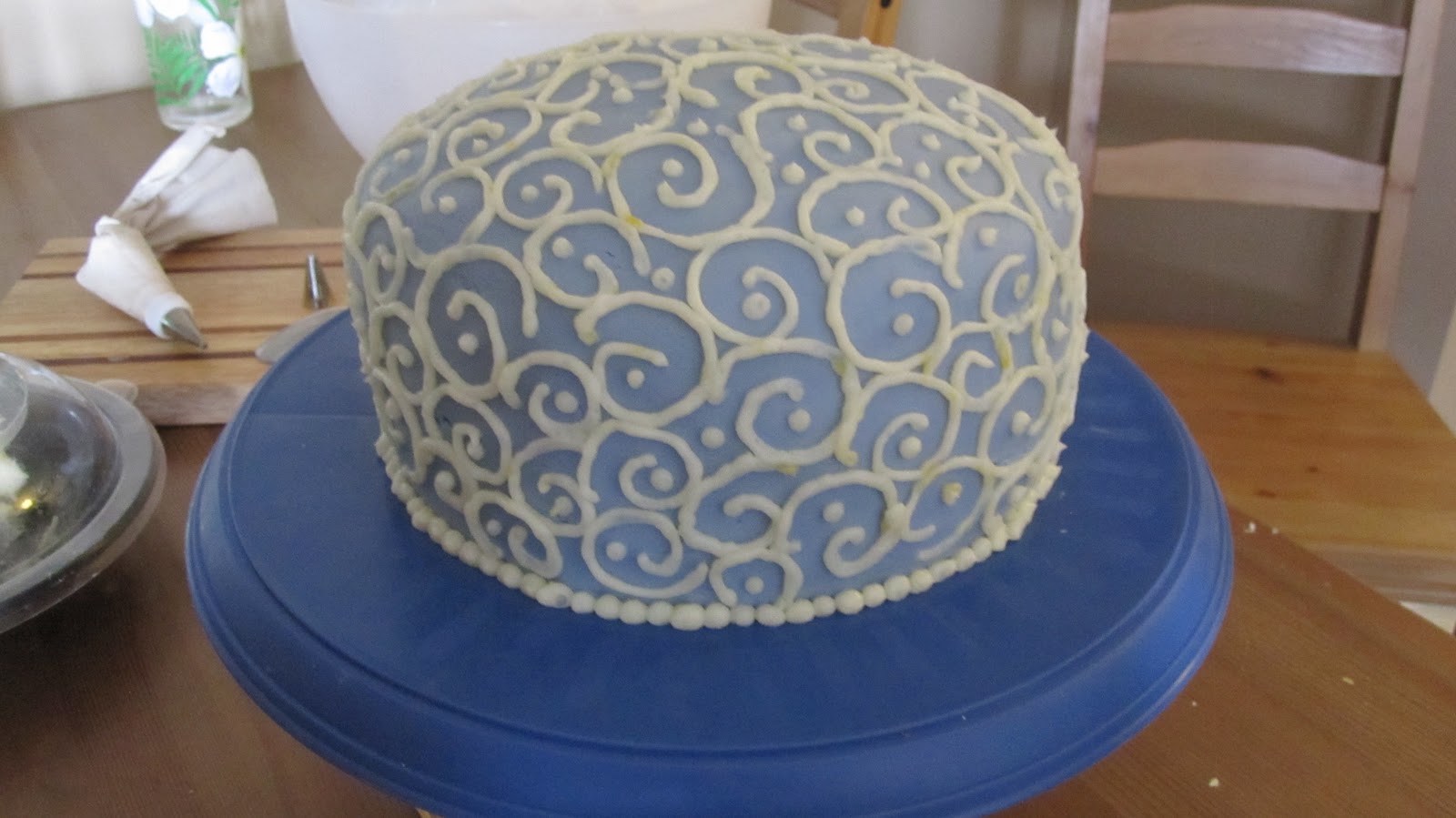
I prepared the rolled fondant the night before by following a recipe off of the Wilton Website. I wasn't quite sure when to stop adding icing sugar to the fondant as I'd never made it before, nor been present when someone else was making it. As a result my fondant was a little stiff, but it seems to have worked out more-or-less. I coloured it a light purple-blue with icing colouring purchased from Michaels. I think it was a garden colours kit. Finally, I had some difficulty with the fondant sticking to my counter, so I laid down a large piece of parchment paper to keep it from getting stuck. It also made the transfer of the fondant to the cake relatively simple.


The fondant transferred and smoothed (relatively). I had some problems getting it totally smooth and I wound up with an unsightly wrinkled section at the back where I couldn't ease out the fondant. I also ended up with some cracks, again suggesting that I'd added too much icing sugar.


The completed cake. Swirls are sort of my fall back when I don't know what else to do for a design. I used left over lemon icing for the pattern. It probably took me no more than twenty-five minutes to do, which was a relief as I was worried the decorating would take an hour. Overall I think it was a very pretty cake, and it tasted delicious.

Ciao,

Andrea